Blog

  • 10 Angular Admin Templates You Should Check Out in 2022

    10 Angular Admin Templates You Should Check Out in 2022

    Are you an Angular Developer looking for some really amazing Admin Templates? Look no further. In this blog, we will give you the list of the top 10 free & premium Angular Admin Templates that you should definitely check out in 2022.
    admin template
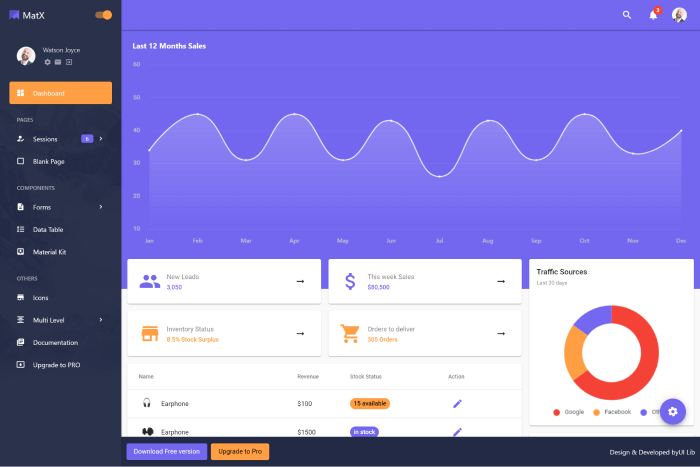
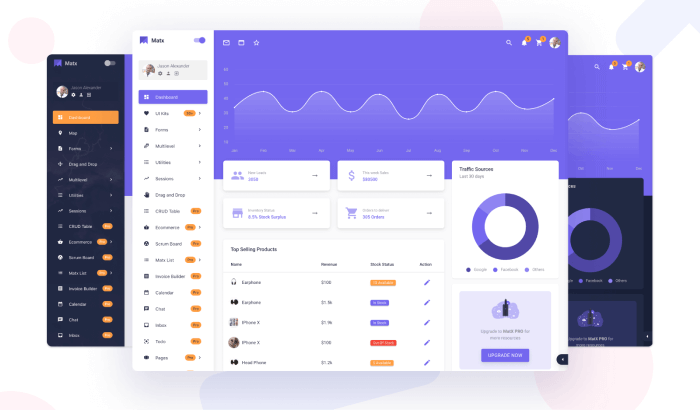
    MatX – Angular Admin Dashboard Template

    Using an admin template to create a dashboard web application is one of the quickest ways to get your project up and running. Admin templates most likely help you build the front-end of your web application in the fastest possible time. They save you both the development time and cost. If you know how to choose an admin template and also know how to implement it in the best possible way, you will see amazing results.

    When you have a limited budget and a tight deadline, a good template is your best friend. They guarantee a responsive UI, a great UX, Dark/Light modes, RTL, Multilingual support, apps (charts, to-do lists, etc), and whatnot. And now, without further ado! Let us now look at the top 10 Angular admin templates that are currently popular on the internet.

    Best Angular Admin Templates

    Angular is an open-source front-end web application development framework built on TypeScript. When it comes to creating an admin dashboard, there is no doubt that a high-quality Angular admin template can provide your project with excellent usability and features.

    However, selecting the best suitable admin template based on your project requirements is quite a challenge. So, we curated some of them that have a wide range of components, features, and customization options.

    Please keep in mind that the list below is in no particular order.

    1. Egret – Angular 14+ Material Design Admin Template
    egret angular material admin template

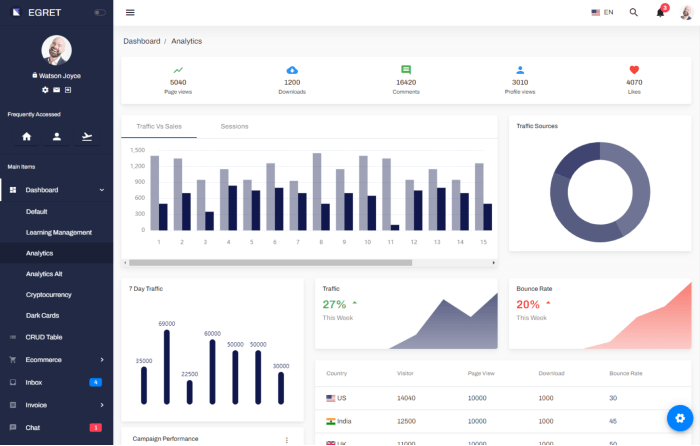
    Egret is an Admin Template built using Angular 14+ & Material Design. It has a large collection of responsive and reusable components. The template gives you access to everything you need to start on your ERP, CRM, or CMS project. There are multiple layouts, lazy loading, dynamic breadcrumbs, and page titles. Also, here you will find model-driven dynamic navigation and multi-language support.

    Moreover, with the template, you will have a wide range of customization options, and prebuilt Dark & Light themes. And, it is good news that the template has no JQuery. Also, it does not have Bootstrap. It’s completely a TypeScript Angular admin dashboard template.

    Built with Angular Material, Flex Layout, and Angular CLI. No Bootstrap!, No jQuery! A pure Typescript Angular admin dashboard!

    Live Preview Details/Download

    2. MatX – Free Angular Admin Template

    matx free angular admin template

    MatX Angular is a free Angular Admin Template. It has the official Material Design components library from Angular. The styles in this dashboard template are written in SCSS. It includes a wide variety of features for your web app development.

    There are JWT Authentication, lazy loaded modules, verticle navigation, and model-driven menu items. Also, here you will find pages like sign in, sign up, forget the password, lock screen, and more. Specifically, you can use this free version template for ERP, CRM, and CMS web app projects. The codes here are well written & structured and also the dashboard is well documented.

    Live Preview Details/Download Premium Version

    3. Gull
    gull angular admin template

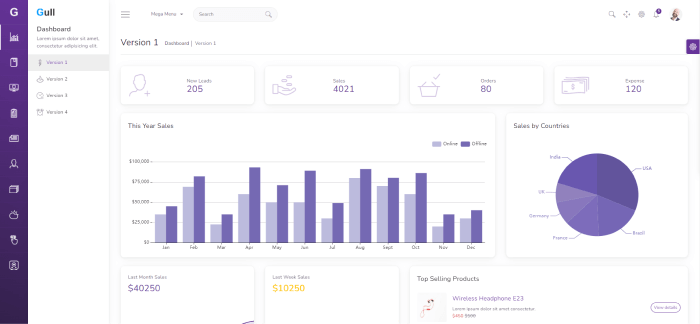
    Gull Angular 14+ Bootstrap 5 Admin Template is a clean design with a modular code structure that makes Angular-based software development easier and faster. It can be used to create custom admin panels, admin dashboards, accounting software, project management, chat applications, calendar schedule apps, eCommerce backends, CMS, CRM, ERP, or SAAS. Built-in angular components will drastically reduce development time.

    You don’t need to write any business logic on the front if you use Gull’s ready-made apps. All you need is a REST API linked to ready-made apps. Also, the template makes use of an in-memory DB API. This means that the table and app demo data comes from an HTTPS call within Angular services.

    Live Preview Details/Download

    4. Xtreme – Angular 13 Admin Template

    xtreme angular admin template

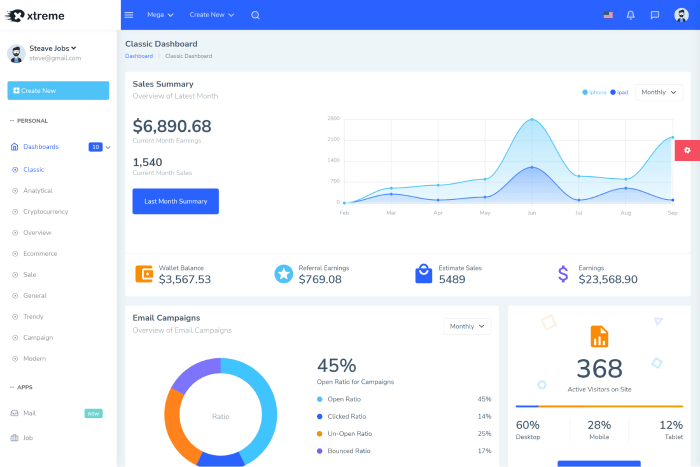
    Xtreme Angular Dashboard is an admin dashboard and control admin panel template for Angular 13 / CLI WebApps. It is a completely responsive Angular 13 / CLI template built on the Angular framework.

    For your backend application user interface, the template offers more than 850-page templates, over 50 ready-to-use Angular components, 10 unique dashboards & demonstrations, and much more. Moreover, its modular design makes it simple to tweak and extend.

    Live Preview Details/Download

    5. Lucid – Angular Admin Template

    lucid anguar admin template

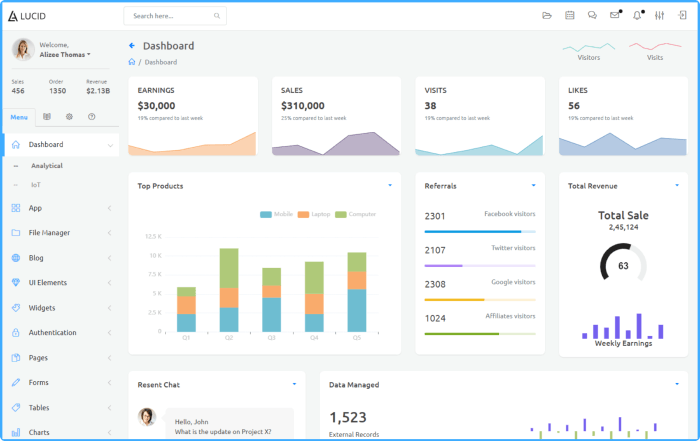
    Another well-structured and documented template is the Lucid Angular Admin template. It’s created using the Angular 13x + Bootstrap 4x framework and is highly responsive. You can use it as an Angular application because it has a consistent design.

    It has a one-of-a-kind dashboard with 50 pages, a timeline view, and easily accessible menu styles. To ensure design consistency, it uses all of the Bootstrap components with Angular layout standards and restyles numerous common plugins.

    Live Preview Details/Download

    6. Enlink – Angular 13 Admin Template

    Enlink

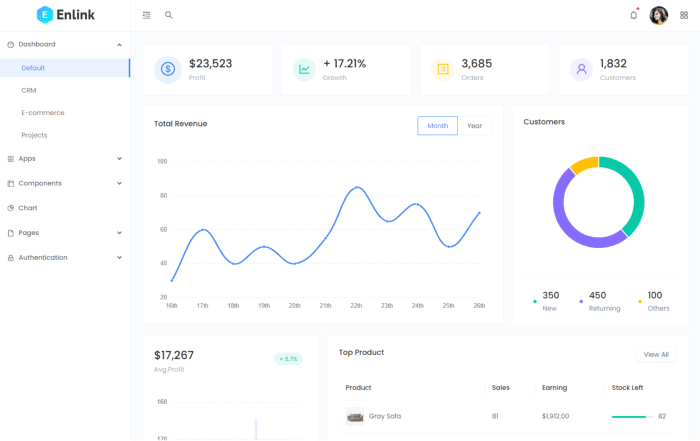
    Enlink is a modern dashboard template that was created with Angular 13 and Ng-Zorro. It has a lot of highly configurable and flexible components that are developed in TypeScript and have well-defined types. Developers may quickly build any project with thorough documentation and clean code! Explore its live preview and details page below.

    Live Preview Details/Download

    7. Skote – Angular 13 Admin Dashboard Template
    skote dashboard

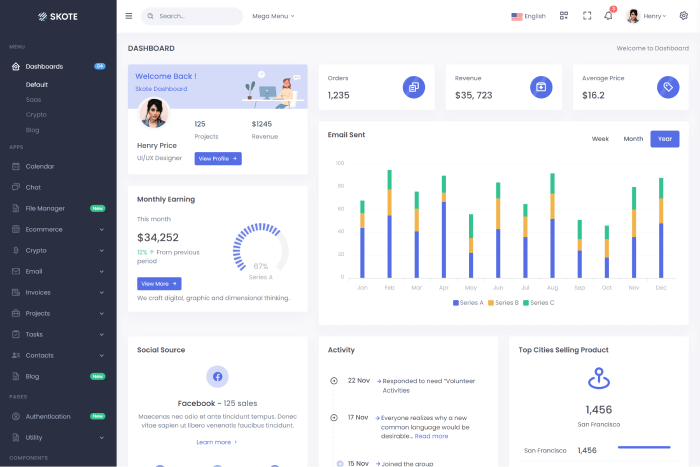
    Skote is an Angular 13 Bootstrap 5 admin dashboard template with a fake backend, Firebase authentication, and language support, as well as developer-friendly coding. This is a template with reusable components that do not need jQuery. With the template, you will get the Sketch, Figma, and XD files, as well as Starterkit.

    It also includes dark and light layouts, as well as RTL options. You can create whatever form of the online application you desire, including SaaS interfaces, eCommerce, CRM, CMS, Project management apps, Admin Panels, and so on.

    Live Preview Details/Download

    8. NGX-Admin – Angular 10 Admin Template
    ngx admin

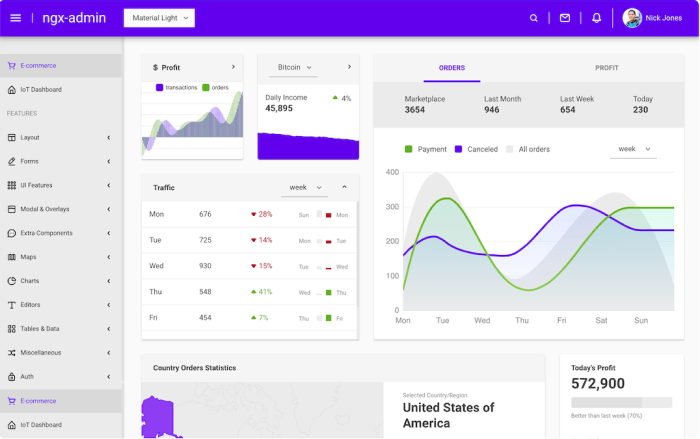
    NGX is a free Angular Admin template (v10) with 4 themes and 2 dashboards. Also, it has an outstanding UI architecture. It’s simple to change the themes and find the right fit for your company. With the template, the developers can focus much better on the business needs rather than wasting time thinking about creating the UI. There are a large number of customized UI components, charts, maps, editors, tables, etc.

    Moreover, it looks stunning because of its amazing responsiveness and perfectly delivers the large screen experience for desktop views. It regularly keeps updating to meet your requirements. And guess what! With NGX, you will have large community support. So far, it has more than 23k GitHub stars and 7.6k forks. Last but not least, it has a wide range of themes available. Therefore, make sure to check out.

    Live Preview Details/Download

    9. Fuse

    fuse dashboard

    Fuse is a multi-layout, flexible Angular 14+ & TailwindCSS admin template. It includes bespoke App and Page layouts, as well as UI elements and the best UX standards. The multi-layout configuration allows you to use multiple template layouts without affecting the overall structure. It also allows you to use a different layout for each route.

    You can be sure about the fact that the template is flexible because it allows you to have any kind of page design within the same codebase. You don’t have to hide/show the layout level elements like navigation, header, or footer all the time. Moreover, it has features like Dark light color schemes, full Angular Material theming support with customizable colors, a ton of applications, and so on.

    Live Preview Details/Download

    10. NobleUI

    Noble UI

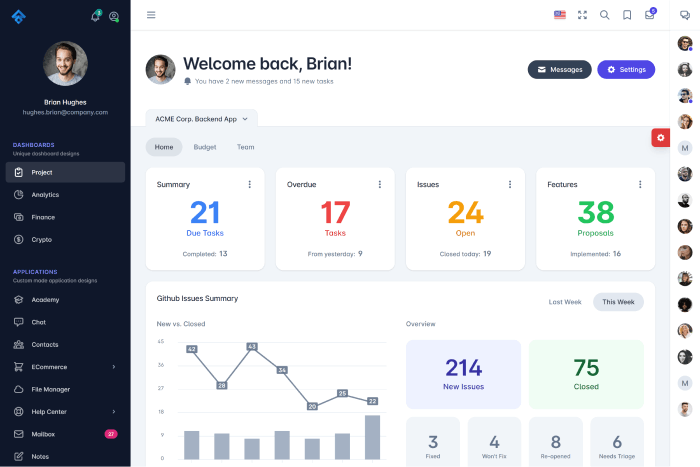
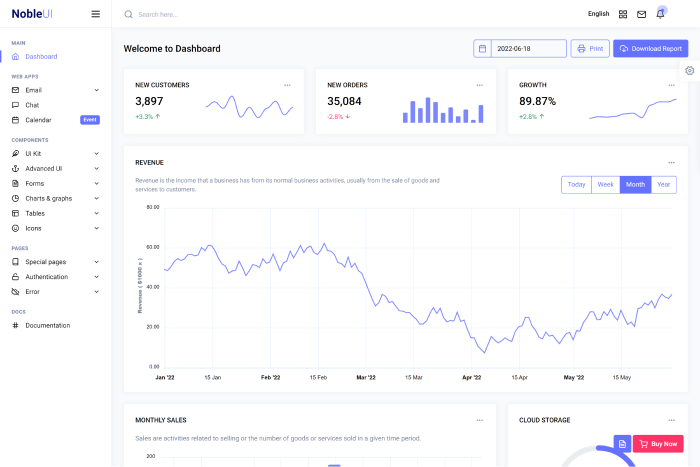
    NobleUi – Angular Admin Template is a lightweight and powerful dashboard template. It is built using Angular 13+ and the Bootstrap 5x Framework. It contains a large library of reusable user interface components and so many designs available for the dashboard. Also, it includes both RTL and LTR support and has a ton of applications.

    The template makes it easier to edit the styles with SASS. And, all of the styles are simple to grasp as they are made using SASS. No surprise, it is a fully responsive admin dashboard that works with all major online browsers and mobile devices. There is no reliance on JQuery.

    Live Preview Details/Download

    Summing Up

    At this point, I believe you’ve discovered what you were looking for. Finding the best suitable admin template is difficult for many of us. Therefore, we came up with the concept of providing our readers with a step-by-step guide to purchasing the perfect admin template. You can also read this guide to ensure everything is in order.

    how to choose an admin template
    How to Choose An Admin Template – UI-Lib’s Blog

    As a software company, we create many of these templates and can guarantee that we’re one of the best in the market in terms of both product quality, positivity, and support.

    Thank you for your time.

    About Us

    At UI-Lib, we develop high-quality free & premium software, templates, design systems, and more. We’re all about delivering services that make a coder’s life easier.
    Similar Articles

  • How To Choose An Admin Template (In 5 Simple Steps)

    How To Choose An Admin Template (In 5 Simple Steps)

    For professionals, it may look like an easy task to choose an admin template, but we bet, for beginners, it is not. Developers often get confused about finding the right one. If you already have experience buying admin templates, you may have faced situations where you have purchased a template and did not receive proper support when needed.

    Also, there might have been cases of poor code standards, incorrect documentation, flexibility issues, etc. For that reason, we have decided to provide our visitors with the 5 simple steps by which they can easily decide on how to choose the right admin template.

    Best React Admin Template
    MatX Pro – React Admin Template

    Now there are over 10 thousand admin templates on the internet. And these are available on different marketplaces such as ThemeForest, MUI Store, Vuetify Store, GetBootstrap, and more. Also, some unique marketplaces like UI-Lib are selling their themes, templates, design systems & full software on their website.

    However, among all these amazing marketplaces and their templates you might end up buying the wrong admin template. It is because everyone is trying so hard to make you believe that they have got everything you need. Also, you may forget to inspect everything properly.

    Remember that all templates have certain limitations, and it is difficult for someone to create a singular admin template with every possibility. Therefore, follow this step-by-step guide and find out which of those templates you should eliminate at first glance, and finally leave with the best suitable one.

    5 Steps To A Perfect Admin Template

    1. Technologies & Frameworks
    2. Design
    3. Features, Usage, Code Quality & Documentation
    4. Technical Support & Updates
    5. Cost, Reviews & Number of Downloads

    1. Technologies & Frameworks

    After defining your project requirements, the first step is to select the right technologies and frameworks. Technologies are programming languages that help you to communicate with machines. In the world, now there are over 300 programming languages.

    Through these languages, we can control and define the actions of machines. So, programming languages are the specific type of languages that help us write programs for machines. On the other hand, a framework in programming is a tool that provides ready-made components or solutions that are customized to speed up development.

    Your selection of the correct technology & framework mostly depends on the project requirements. At first, you have to be sure about your requirements, and based on those requirements, you will choose the technologies and frameworks with which you will run your program.

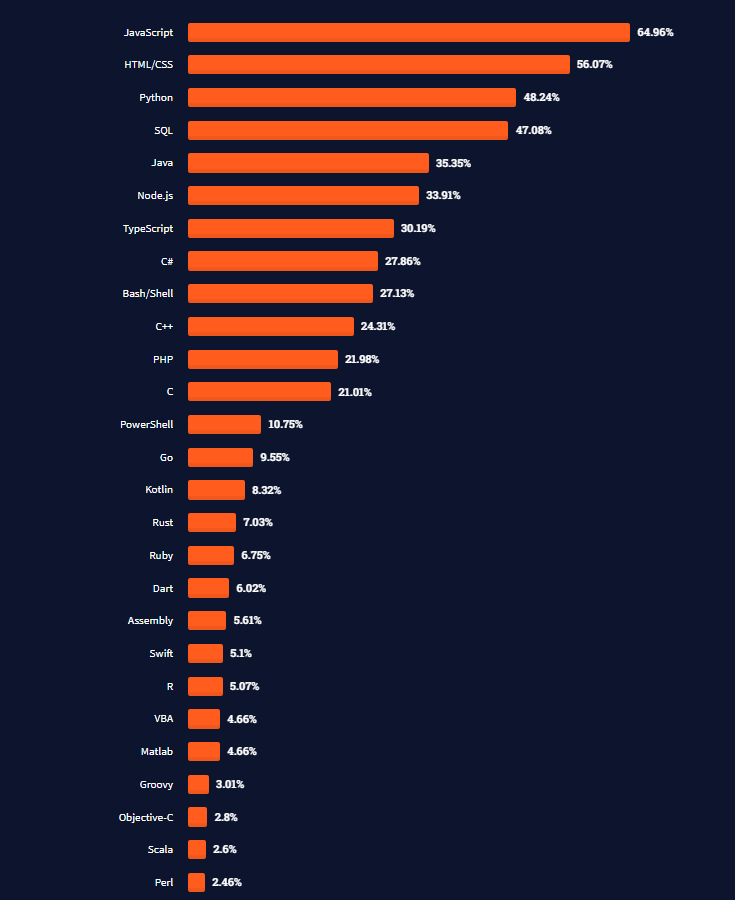
    Here’s a list of the most trending technologies according to Stack Overflow Survey 2021.

    stackoverflow programming language popularity survey 2021
    Source: Stack Overflow

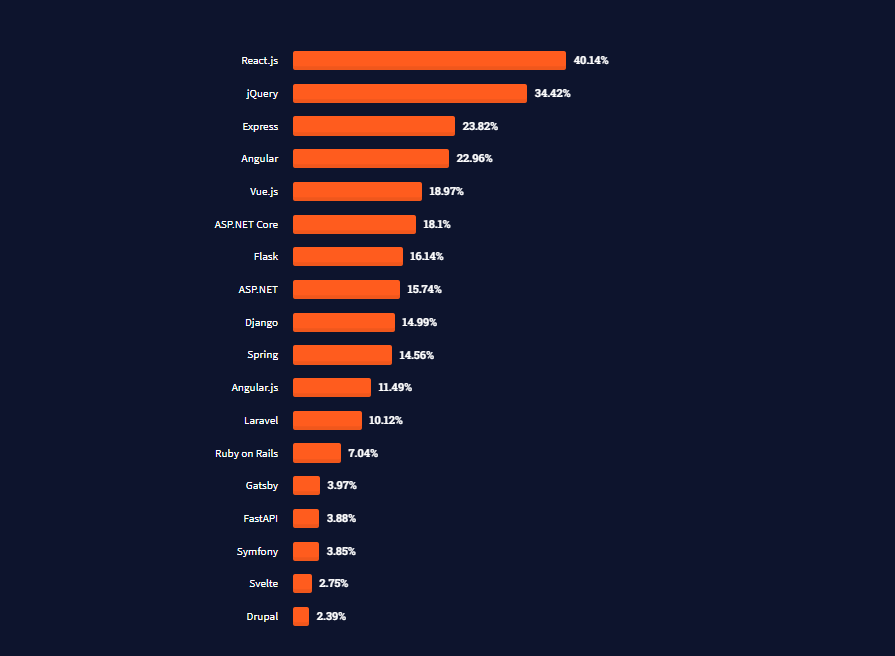
    Also, check out this list from Stack Overflow Survey 2021 that shows the most trending frameworks.

    trending programming frameworks list 2021
    Source: Stack Overflow

    Types of Frameworks

    In programming, a framework is a tool that provides pre-built components or solutions that may be changed to speed up development. A framework can incorporate a library, but it is characterized by the inversion of the control principle (IoC). There are a lot of frameworks available. Here are some trending ones you can consider while choosing an admin template.

    • Front End Frameworks – React, Vue, Angular, etc.
    • Server-Side Frameworks – Node.js, Laravel, etc.
    • Styling Frameworks – Bootstrap, TailwindCSS, Material UI, etc.

    JavaScript Frameworks

    For developing dynamic websites, JavaScript is the world’s most advanced and popular programming language. With JavaScript, you can edit the content on the document, control browsers, and more. When it comes to supporting browsers, JavaScript supports all the major ones. Moreover, in terms of the popularity and development of web applications and games, the language has no competition.

    Also, to make the development quicker, JavaScript has frameworks like Angular (Frontend + Backend), React.js, Vue.js, Gatsby.js, Node.js, etc. And, built on React, there is a framework called Next.js. Similarly, built on top of Vue.js there is Nuxt.js. Next.js & Nuxt.js are two great JavaScript frameworks. So, these are some of the most trending JavaScript Frameworks known to all.

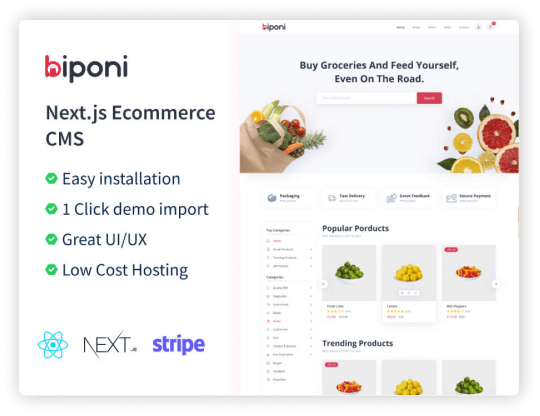
    https://ui-lib.com/downloads/biponi-nextjs-ecommerce-cms/
    • Angular.JS – Front-end & Backend Javascript framework
    • React.JS – Front-end Javascript framework
    • Vue.JS – Front-end Javascript framework
    • Node.JS – Server-side Javascript framework

    However, if you want to use an alternative to JavaScript for the front end, you have TypeScript. You can go for that too. In some cases, you’ll find admin templates that are a mix of both JavaScript and TypeScript.

    Uko – Client & Admin Dashboard (JavaScript + TypeScript + MUI + Figma File)
    uko client & admin dashboard template
    Uko – Client & Admin Dashboard

    Live Preview Details / Download

    Other Frameworks

    To create an admin dashboard you’ll need different types of frameworks. There are frameworks like front-end frameworks like React.js, Angular, or Vue.js. Also, there are backend frameworks like Laravel, Node.js, and Styling frameworks like Bootstrap and Material UI. So, other than JavaScript there are frameworks for different purposes. For example, Laravel is for server-side backend development. Also, there are Bootstrap, Material UI, and TailwindCSS for styling the components inside a web application.

    Backend Framework

    Laravel is a framework known for its ability to help developers with authentication, routing, sessions, and caching. It is an open-source framework built using core PHP. PHP is the basic scripting language, on the other hand, Laravel is its full-structured framework. Both are great tools for making worthy web apps for the end-user.

    If you are comfortable with Core PHP and Advanced PHP and want to build a web application from the ground up, Laravel will save you time. If you’re eager to work with the Laravel framework, look at some samples of Laravel Admin Templates to see how you can apply them to your project.

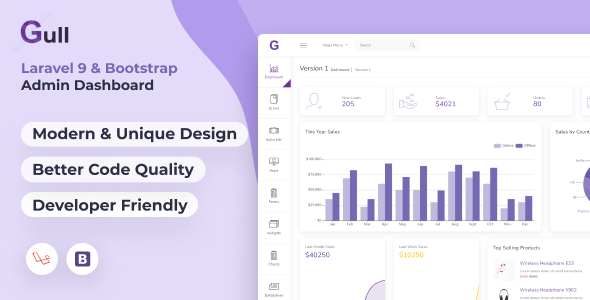
    Gull – Laravel & Bootstrap Admin Dashboard Template

    gull

    Live Preview Details / Download

    Styling Framework

    For styling the components in a web application, there are frameworks as I have mentioned above. Though all of them have one singular purpose, and that is to style the components. However, in terms of approach, they are different.

    For example, Bootstrap is a popular open-source styling framework for developing responsive web apps with HTML, CSS, and JavaScript. It has recently launched its 5th version. It is a framework to give you ease in developing highly responsive, easy-to-use, and super customizable web applications. So, for styling an admin template, you should keep an eye on that.

    Also, for styling, there are Material UI, TailwindCSS, etc. Choosing one of them depends on your preference. Most developers favor all of the frameworks mentioned above, and you can use them for your projects depending on their ability to perform and responsiveness.

    2. UI Design

    In the UI Design Stage, you select the type of UI Design you want in your dashboard at first. It will be the graphical layout of your web application. It includes everything the user interacts with inside the Dashboard. For example, buttons, texts, images, forms, menu & layouts, components, themes, pages, and more. It is the outlook of your web application.

    Selecting the UI Design of your dashboard is comparatively easy. First, you need to go through the demos that catch your attention. Checking the live demos will help you better understand how it will work. Check if it looks responsive. Being mobile-friendly doesn’t confirm responsiveness. Sometimes it happens that a design seems perfectly okay for multiple devices. But based on its usability and UX, you need to decide whether you should go for that particular template or not.

    Generally, there are 6 types of variation in the design of an admin template. We highly prefer to look out for Material Design and Clean & Minimal Design. Here are examples of different design approaches with hyperlinks to admin templates based on the category.

    3. Features, Usage, Code Quality, and Documentation

    The feature reflects a template’s functionality and ability to perform, which means the things you can do with the template. On the other hand, the code quality, documentation & changelog shows how easy it will be for a developer to use and understand the coding & files for implementing his work with the template.

    All of these three factors define the usage of an admin template. So, these are very crucial aspects when it comes to choosing the best template. Usually, authors reveal their folder structure and code quality in the documentation for user awareness.

    However, sometimes we see many admin templates have high code quality, but the page loading speed is poor. You should always avoid that kind of admin template. To see if the loading speed of an admin template is good enough or not, you can put its URL in the GTmetrics tool.

    Below are core features you need to check out while choosing an admin template.

    • Technologies & Frameworks
    • Responsiveness
    • Browser Support & Device Support
    • Scalability
    • RLT & Multilingual Support (If necessary)
    • Dark & Light themes
    • Applications & their built quality
    • Security
    • Customization & Integration

    4. Support & Updates

    After selecting an admin template, inspect all the sections and evaluate them based on your requirements. You can now step into the last two phases. The first point among the final two stages is its Support & Updates.

    The update includes the template’s most recent features. Also, this includes security patches and bug fixes. It assists you in determining whether or not the project is improving over time. It also makes an admin template more stable. The admin template you’ve chosen should be compatible with the most recent framework version. And it should have a minimum of one year with updates. Keep in mind that manually updating the template may break your entire project.

    Despite purchasing a perfect admin template, you may encounter some technical difficulties. Furthermore, you may be unable to comprehend the process of incorporating the codes into your project. In this case, the template provider’s support team will assist you in resolving the issues.

    If you are having difficulty understanding how the template works from the inside, the support team can guide you with that. Therefore, before purchasing an admin template, double-check the support policy.

    5. Cost, licenses, Reviews & Downloads

    Budget is a major concern when it comes to buying an admin template. A free template in most cases cannot compete with the premium ones. Premium admin templates are always rich with features and have a huge library of components. For beginner developers, a free admin template works as a guide, but for large-scale projects, we highly recommend you go for the premium ones.

    A premium license generally comes in two options, 1. Regular or Standard License, and 2. Extended or Developer License. An admin template with a regular license can cost you somewhere around $14 to 59$. However, if you find an admin template available in both free and premium versions, you should first try the free template and see how it performs. If the free version performs well, go for the premium version.

    So, first, set a budget for an admin template and purchase a regular license to find out how the premium version works. You should also carefully examine their customer reviews. The authenticity of an admin template is reflected in it its detail section. If it has lots of positive reviews, it is almost certainly worth using. Furthermore, the total number of downloads can help determine the product’s popularity.

    Wrapping Up

    Finally, it seems like your quest for how to choose an admin template has come to an end. Conducting research before buying an admin template is crucial for any project. If you overlook any of these points mentioned above, you may end up buying the wrong one. For these reasons, we believe that after considering all of the factors, you should consider purchasing a premium admin template. It is because a premium admin template typically has a high level of flexibility and scalability, as well as proper documentation, and provides excellent technical support.

    On UI-Lib, we create admin templates that take all of the above parameters into account and save you time to choose an admin template for your next web/app project.

    Thank you for your time!

    About Us

    At UI-Lib, we develop high-quality free & premium software, templates, design systems, and more. We’re all about delivering services that make a coder’s life easier.
    Similar Articles

  • 9 Awesome NextJS Starter Templates Worth Checking Out in 2024

    9 Awesome NextJS Starter Templates Worth Checking Out in 2024

    Nextjs Starter Templates are fully functional & open-source website demos made with the Nextjs framework that you can import into your site. You can import the template and then modify it as you need. Also, you can add and design additional pages. And, Adding a legal page to your website is as simple as adding any other new page.

    nextjs starter templates

    Here, we are going to help you find the top 9 Nextjs Starter Templates that are open-source and might be useful for your next project.

    Top Nextjs Starter Templates

    The list below is in no particular order.

    1. NextJS Landing Page – Starter Template

    NextJS Landing Page Starter Template

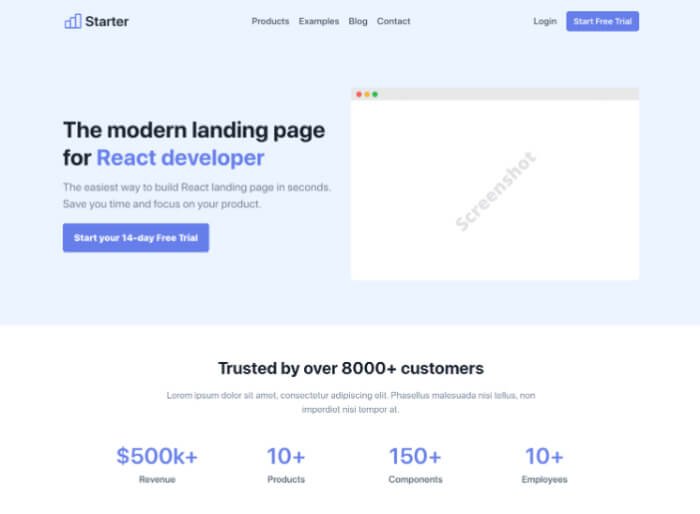
    This is a free & open-source landing page made with Nextjs, TailwindCSS 3, and TypeScript. It is built using Next.js, TypeScript, ESLint, Prettier, Husky, Lint-Staged, VSCode, Netlify, PostCSS, and TailwindCSS in mind. And, to use it on your next project, simply clone it, and you’re ready to go.

    GitHub Demo

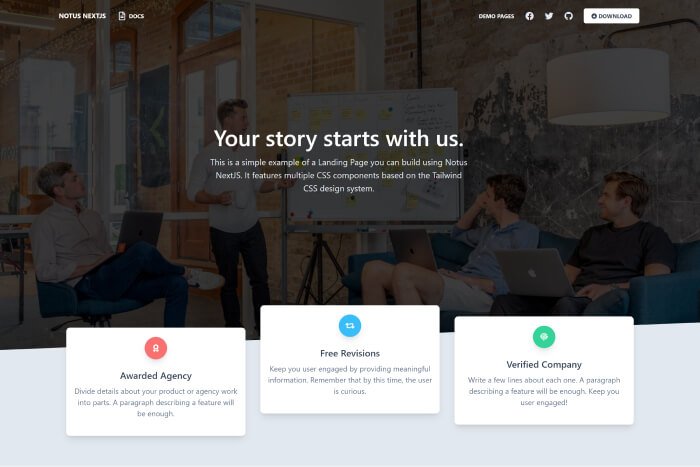
    2. Notus Nextjs

    Notus Nextjs

    Notus is a beautiful UI Kit and Admin for Tailwind CSS and NextJS. The template has a lot of cool features that you can hardly find in any other starter templates. It includes dynamic NextJS components as well as multiple HTML and NextJS elements. Also, it includes presentation pages as well as admin dashboard pages. If you like vibrant colors, you’ll love this Free Tailwind CSS Template! It includes a plethora of components that can assist you in creating stunning websites.

    GitHub Demo

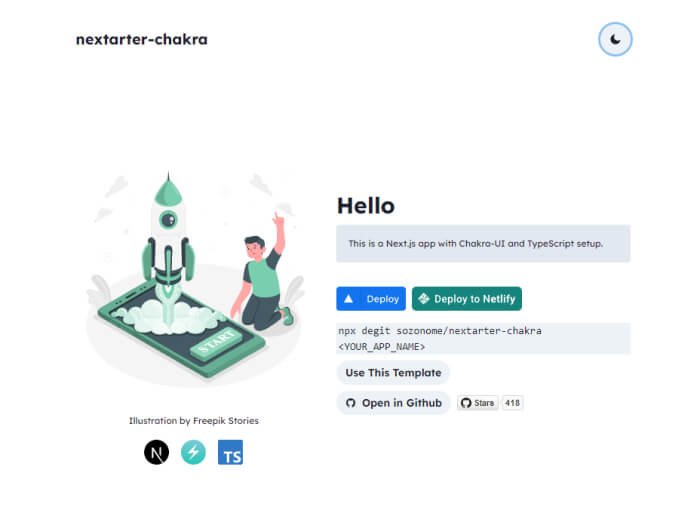
    3. Nextarter Chakra

    nextarter chakra

    This is another great example of Nextjs Starter Templates. The template has features like PWA ready, SEO optimization ready, basic responsive layouts, etc. It has all the toolings for lining, formatting, and conventions. So, this is a Nextjs project using create-next-app and has Chakra UI and TypeScript setup. With this starter template, you can begin developing immediately!

    GitHub Demo

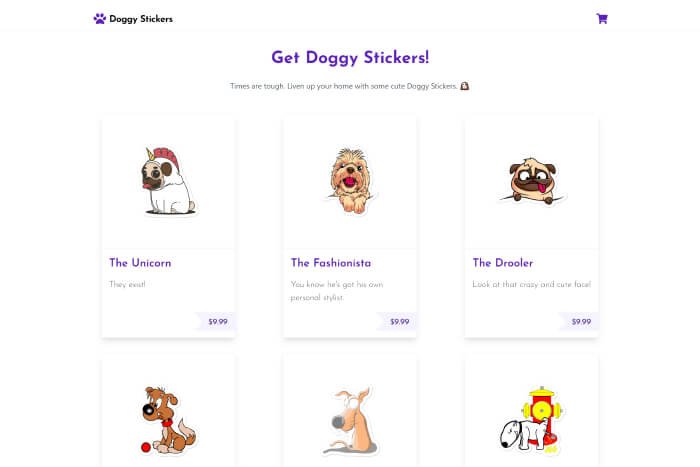
    4. Next Shopify Starter – Nextjs Starter Template

    nextjs shopify starter software

    Next Shopify Starter is a fully functional eCommerce store. It interacts with your Shopify backend using Next.js + Tailwind CSS on the front end and the Shopify Storefront API on the back end. Furthermore, it uses GraphQL to query Shopify data and save cart information in localStorage to keep the user session alive.

    Also, it has Shopify Checkout, which allows the user to purchase the items. This is demonstrated in the example store. The shop is functional and you can purchase stickers.

    GitHub Demo

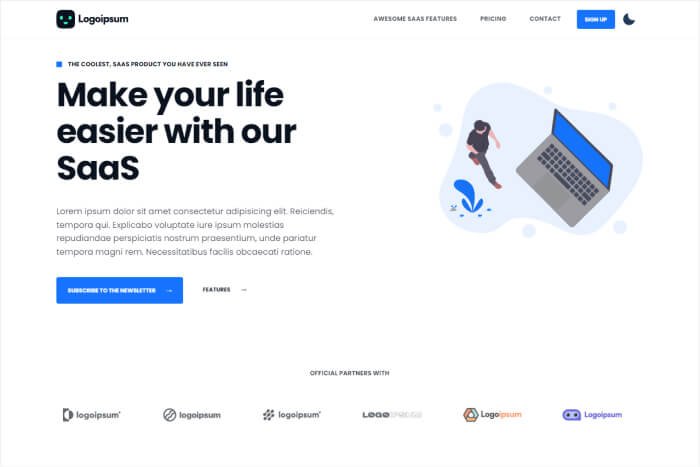
    5. Next SaaS Starter – Nextjs Starter Template

    Nextjs Saas starter

    Next Saas Starter is a free Nextjs responsive Starter Landing Page Template. It is for Saas products built using JAMStack architecture. If you need to make a marketing website with Nextjs and a great landing page with amazing SEO metrics, Green Web vitals, Performance, and a Clean & Pragmatic Codebase, you can consider this starter template.

    Also, it has more features such as Dark mode available, customization options, Mailchimp integration for the newsletter, the blog section with MDX, one-click deployment, ESLint, etc. Make sure to check out.

    GitHub Demo

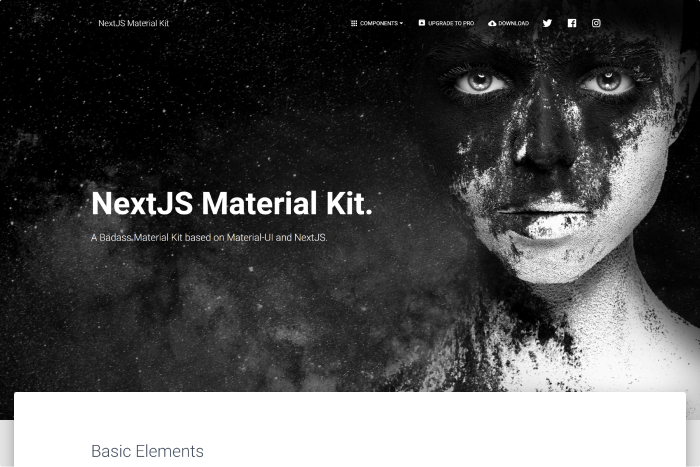
    6. NextJS Material Kit

    nextjs material kit

    NextJS Material Kit is a Free Material-UI Kit. It is built with NextJS. Begin with this starter project created with Material-UI and Material Kit React. It has a visually appealing set of components. Along with the restyled Material-UI elements, there are three fully-coded example pages to assist you in designing your NextJS project. It has a ton of features with all the latest updates available.

    GitHub Demo

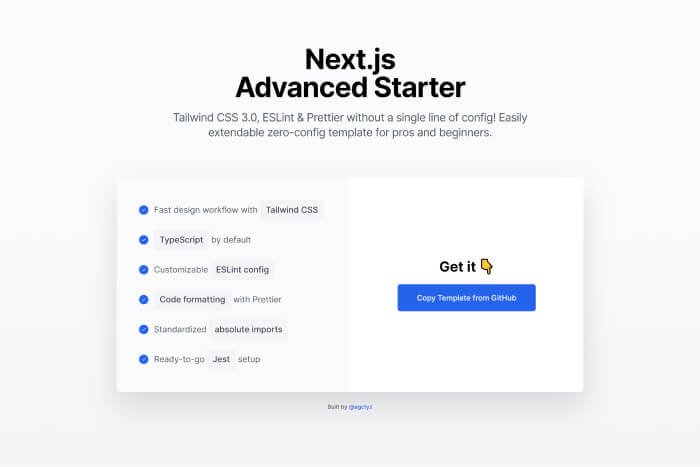
    7. Nextjs Advanced Starter

    advanced starter nextjs

    This is an opinionated Next.js starter skeleton with advanced features. You can use Tailwind CSS, ESLint, Prettier, and absolute imports right away with this starter template. It is also a zero-config template that is easily extendable for both pros and beginners. Don’t forget to check it out.

    GitHub Demo

    8. Nextal – Nextjs Starter Template

    Nextal Nextjs Starter Template

    This is also an excellent NextJs with a TypeScript starter template. It supports Tailwind with CSS Modules. Also, there is Jest and @react/testing-library are set up and ready to use. Moreover, the components here include ESLint, Prettier, Husky, Commit-lint, and Atomic Design.

    GitHub Demo

    9. Next Starter – Nextjs Starter Template

    Next Starter is a Next.js Starter using Nextjs, GraphQL, TypeScript, Babel, and other amazing technologies. This is a complete product. Starter template for Next.js. This boilerplate is used in the production of the Erion Classroom. With secure, httpOnly options, you can store the authentication status in a cookie.

    Note: However, now this repository has been archived by the owner. It is now read-only.

    GitHub Demo

    Wrapping Up

    Finally, your search for good Nextjs Starter Templates appears to be over. It is critical to choose the right Starter Template, especially for scaling, future app or website maintenance, configuration setup, and so on. We wish you continued success with your Nextjs projects.

    Happy Coding!

    About Us

    At UI-Lib, we develop high-quality free & premium software, templates, design systems, and more. We’re all about delivering services that make a coder’s life easier.
    Similar Articles

    1. Nextjs vs Nuxtjs: Which One Should You Use?
    2. Best NuxtJS Templates
    3. VueJS Boilerplates That You Shouldn’t Miss
    4. Free VueJS Admin Templates
    5. VS Code Extensions for Vue That You Cannot Miss
  • 30 Nextjs Extensions For Faster Development in 2022

    30 Nextjs Extensions For Faster Development in 2022

    A JavaScript framework extension is a piece of pre-coded program that enhances or extends the framework’s capabilities. An extension adds new features to an existing standalone framework. These extensions themselves are not independently functional. They need a framework with which they can work. And, it is to give you a faster development experience. Similarly, adding or installing a Nextjs extension will help you finish your project faster. It will relieve you of the burden of creating new functionalities for the project from scratch.

    Various functionality-based extensions are available on both the Visual Studio Code Marketplace and GitHub. However, it is time-consuming to search the marketplace or Github for something you are unaware of. For that reason, we have carefully curated this collection. It is to provide you with some of the best Nextjs Extensions that you’ll be happy to know about.

    Nextjs Extensions

    So, next time when you start a Nextjs project, take a look at these extensions that could end up saving you days of hard work.

    Hey Devs! This is the best NextJS eCommerce CMS (full software) available on the internet. 👇😎

    https://ui-lib.com/downloads/biponi-nextjs-ecommerce-cms/

    NextJS Extensions

    The list we’re about to show you is in no particular order.

    1. Universal Language Detector — Nextjs Extension

    This extension works as a universal language detector for both browser and server. On the server-side, this will rely on “cookies > accept-language header”. On the other hand, on the browser side, it will rely on “cookies > navigator settings”.

    Note: This library can only help you resolve the language (frenes, etc.), not the locale (fr-FRen-US, etc.)

    GitHub Demo

    2. Next Routes — Nextjs Extension

    Next Routes are easy to use universal dynamic routes for Next.js. Now, the extension has more than 10k users. It can be used for both client and server-side and has features like,

    • Express-style route and parameters matching;
    • Request handler middleware for express & co;
    • Link and Router that generate URLs by route definition.

    GitHub

    3. Auto Close Tag

    This extension adds the HTML/XML close tag automatically. As a result, after typing in the closing bracket of the opening tag, the closing tag will be automatically inserted. It works exactly like Visual Studio IDE or Sublime Text. This extension is also available in other languages. For example, XML, PHP, Vue, JavaScript, TypeScript, JSX, TSX, and so on. It can be customized.

    Learn more about this useful extension from the button below.

    More Info / Install

    4. Auto Rename Tag

    The Auto Rename Tag extension auto renames the paired HTML/XML tag. It does the same as Visual Studio IDE.

    More Info / Install

    5. Next Plugin GraphQL

    If you want to use GraphQL with Nextjs this extension will help you do that. It is a Nextjs plugin for .graphql and .gql files using graphql-tag.

    GitHub

    6. Next SEO — Nextjs Extension

    The Next SEO is a nextjs extension for easily managing your SEO in Nextjs projects. The plugin works by including it on pages where you likely want to add the SEO attributes. And, once it is included on the pages, you pass it a configuration object with the page’s SEO properties. This can be generated dynamically at the page level, or your API may return an SEO object in some cases.

    GitHub

    7. Next Cookie — Nextjs Extension

    Simply the Next Cookie is a Nextjs extension for cookie serialization and deserialization. That means it is a cookie serializer & deserializer library for NextJS. This is a very useful library and is used by many NextJS developers.

    GitHub NPMJS

    8. Nextein — Nextjs Extension

    If you want to write static sites with Markdown + React and Nextjs. This should be your go-to NextJS extension. It is a wrapper around Nextjs that allows you to write static sites using markdown and react. To run the Nextein command, you need the NodeJS v10.x+.

    GitHub

    9. Next — i18Next

    With this extension, you can easily translate your NextJS apps. Although NextJs directly provides internationalized routing, it does not handle translation content management or translation functionality. NextJs only keeps your locales and URLs in sync.

    This extension is very easy to set up and use. The step ends in just a few steps and the configurations are pretty simple. To learn more about this awesome Nextjs extension click the button below.

    GitHub

    10. Next MDX Blog — Nextjs Extension

    Go for this extension to add a blog section to any NextJS-based project. It has some really useful features like an MDX blog, RSS Feed, Simple Setup, and Customizable rendering. Your blog posts can be saved anywhere in the page’s directory. However, in order to keep things tidy, you will need to keep all blog posts on pages/blogs.

    To build your blog index, you must include the next-mdx-blog plugin in your next.config.js file. To parse your blog posts, you must also include @zeit/next-mdx.

    GitHub

    11. React and Next.js Snippets

    This is a Visual Studio Code extension that provides a ton of React and Next.js snippets with TypeScript support. It allows you to avoid rewriting the same code again and again.

    More Info / Install

    12. Better Comments

    If you want to improve your code commenting by annotating with alerts, informational, TODOs, and more, try The Better Comments. It will help you to create more human-friendly comments in your code. With this extension, you will be able to categorize your annotations into;

    • Alerts
    • Queries
    • TODOs
    • Highlights

    and more.

    More Info / Install

    13. axe Accessibility Linter

    With axe Accessibility Linter, your coding for accessibility will be easy. It is an accessibility linting for HTML, Angular, React, Markdown, and Vue. There are several useful features. Some of them are,

    • React (.js.jsx.ts.tsx), Vue (.vue), Angular (.component.html), HTML, (.html.htm), and Markdown (.md.markdown) files are all checked. Its purpose is to assist you in avoiding common accessibility flaws. Angular templates inline are not currently supported.
    • Needs Zero configuration.
    • Consistent with the open-source axe-core rules engine in providing early warnings of legit accessibility flaws, with no false positives. As a result, you don’t need to create a slew of ignoring flags.
    • Shareable project-specific configurations.

    etc.

    More Info / Install

    14. Blockman — Highlight Nested Code Blocks

    Blockman is a VS Code extension for highlighting the next blocks. It is easy to start working with an easy to disable. You can disable Blockman for certain files. It has added new color combos, the hidden backgrounds, and keeps only borders. Moreover, you can highlight all the parents of the focused block.

    More Info / Install

    15. Bookmarks — VS Code Extension

    Bookmarks is an extension for Visual Studio Code. Recently, it has added some new things like icon customization, sticky engine, and virtual workspaces support. Also, it supports workspace trust and full remote development.

    The extension helps you to easily navigate through important positions of your codes. It supports selection commands. This allows you to select lines that you bookmarked and also regions between the bookmarked lines. It is useful for log file analysis.

    So, you can mark and unmark positions in your code. You can mark positions and give them a name. And, you can jump between these bookmarks. There will be a dedicated sidebar for bookmarks and many more useful features.

    More Info / Install

    16. Code Spell Checker

    Code Spell Checker is a straightforward spell checker that works well with camelCase code. The primary goal of this spell checker is to detect common spelling errors while minimizing false positives.

    It works simply. If you load JavaScript, TypeScript, Text, etc. files, the words that are not in the dictionary list will have a squiggly underline.

    More Info / Install

    17. Serverless NextJS

    If you are looking for an extension that can help you with deploying your Next.js apps on AWS Lambda@Edge via Serverless Components, this is it. Serverless Nextjs extension is a popular zero-configuration plugin for Nextjs.

    It has a ton of features and you must check out the details carefully before starting with this extension.

    GitHub

    18. NextJS Iron Session

    Iron Session is a Node.js stateless session utility that stores data in the signed and encrypted cookies. This extension is compatible with any Node.js HTTP framework, including Next.js, Express, NestJs, Fastify, and others.

    The data is stored in encrypted cookies. Only the developer has access to the session data. Because there are no session ids, iron sessions are “stateless” from the server’s side.

    Frameworks like Ruby On Reils has the same approach. And, it is one of their default strategies.

    Demo GitHub

    19. Next PWA — Nextjs PWA Plugin

    The Next PWA is a zero-configuration PWA Plugin by workbox for Next.js. It has a ton of features that includes,

    • Zero configuration for registering and generating a service worker;
    • Optimized precache and runtime cache;
    • Maximize lighthouse score;
    • Easy to understand examples;
    • Full offline support with fallbacks example;
    • Work with cookies out of the box;

    and a ton more. Make sure to check out.

    GitHub

    20. Next Img — Nextjs Plugin

    This is a Nextjs plugin for embedding optimized images by Humaans. By default, the configuration is set to use, 1 breakpoint at 768px, output the original and webp formats, 2-pixel densities of 1x, 2x. However, you can change these settings in your next.config.js or in the individual image imports.

    It has a lot of features that you definitely need to check out from the buttons below.

    Demo GitHub

    21. Next Auth — Nextjs Authentication Extension

    NextAuth.js is the most popular open-source authentication framework for next.js applications. So far, the extension has 10.3k GitHub stars and 1.2k Forks. It is built from scratch to support Nextjs and Serverless.

    GitHub

    22. Color Highlight — Nextjs Extension

    The Color Highlight is a simple extension that you can use while writing NextJS. It highlights web colors in your code editor.

    More Info / Install

    23. Git Graph — Nextjs Extension

    Git Graph is a cool extension that you can use for Nextjs developments. With the extension, you can easily view a Git Graph of your repository, and then perform Git actions from the graph. It includes a huge an amount of features that you must have a look at. On the marketplace’s details page, you’ll find a demo of what it looks like to work with.

    More Info / Install

    24. Next Transpile Module – Nextjs Extension

    If you want to transpile your code from your node_modules, this is what you need. Easily transpile modules using Nextjs Babel configuration. This plugin supports transpilation of all extensions supported by Nextjs. Also, it enables hot-reloading on local packages, and most of the setups should work out of the box. For example, npm, yarn, pnpm, etc.

    GitHub

    25. Destack — Nextjs Extension

    Destack is a page builder based on Next.js, TailwindCSS, and Grape.js. It will help you to build visually correct landing pages in your React or Nextjs projects. You can quickly deploy them and it doesn’t need any configuration. Also, it supports asset uploading, from submission and a variety of Tailwind colors. Some of its features are,

    • Powerful Blocks;
    • Delightful Builder;
    • Data Ownership;
    • Assets and Form Support;
    • Easy Setup and Deployment.

    GitHub

    26. Debugger for Chrome

    Debugging is a lot like console.log(). With the debugger extension, you can see every variable value and stop at any point in your application building process. However, it takes time to learn how to use the Debugger instead of console.log(). But after you know how it gets done, it will be a breeze for you to work with the Debugger extension.

    More Info / Download

    27. Next.js Snippets

    This is a collection of snippets for Next.js development by Pulkit Gangwar. It contains the latest snippets for page initialization, nextjs, custom app, and document, api routes, static generation, importing components, and more.

    More Info / Install

    28. GitLens — Git supercharged

    GitLens uses Git blame annotations and CodeLens to help you visualize code authorship at a glance. You can navigate and explore Git repositories with ease, gaining valuable insights through rich visualizations, powerful comparison commands, and much more. Learn more.

    More Info / Install

    29. EsLint

    EsLint is an extension for VS Code. It finds the problems in code, fixes them automatically, and also you can customize the way it should work based on your requirements. It statically analyses your code to quickly find the problem, and it fixes syntax awareness, so you will not experience any errors introduced by traditional find-and-replace algorithms.

    More Info / Install Documentation

    30. Path Intellisense

    Path Intellisense is another VS Code extension that you can use for writing Nextjs. The plugin autocompletes filenames. So, now you don’t have to write the full name of a file, instead just a few initial letters will be enough.

    More Info / Install

    More Extensions for Nextjs Worth Checking Out

    Wrapping Up

    So, it looks like your quest for the best Nextjs Extensions has now come to an end. Selecting the right extensions can give you a lot of flexibility while developing a project. It will give you a faster coding experience and lessen the burden of working extra hours.

    Happy Coding!

    About Us

    At UI-Lib, we develop high-quality free & premium software, templates, design systems, and more. We’re all about delivering services that make a coder’s life easier.
    Similar Blogs

    https://ui-lib.com/downloads/bazar-pro-react-nextjs-ecommerce-template/

  • Top 8 Nuxtjs Boilerplates You Should Check Out In 2022

    Top 8 Nuxtjs Boilerplates You Should Check Out In 2022

    Are you looking for Nuxt boilerplates? You’ll find all the great ones here. In this blog, we will learn and find out all the major Nuxtjs boilerplates that you definitely need to check out in 2022.

    nuxtjs boilerplate

    Click HERE to learn about what is a boilerplate, evaluation points, the benefits of using one, when to use it, and the basic differences between a boilerplate and a starter kit.

    Top Nuxtjs Boilerplates

    The list below which we are about to showcase to you does not follow any particular order.

    1. Front-End Boilerplates – Nuxtjs

    This boilerplate includes all the latest and relevant technologies. The boilerplate includes Vue, Nuxt, TypeScript, Express, Linting, SASS, BEM (Non-Strict) + BEMIT. Before you start with the template, download or clone the boilerplate and make sure to install all the dependencies.

    Install / Download GitHub

    2. Electron Nuxt Boilerplate

    It is a starter project boilerplate that combines Nuxtjs with Electron for rapid application development. The installation process requires Node Version 8 and an NPM version 4. Depending on the needs of your project, you may need to add additional modules to this boilerplate. You might want to include node-postgres to communicate with the PostgreSQL database, or material-ui to reuse react UI components.

    GitHub

    3. Nuxt CoreUI

    Nuxt CoreUI is an unofficial Nuxt + Core UI project. It is a free project that allows you to use it for any Nuxtjs project. To use this project first you must need to install NodeJS and Vue CLI on your local machine. The rest of the information is in the link below.

    GitHub

    4. Laranuxt – Laravel + Nuxtjs Boilerplate

    The Laranuxt is a Laravel and Nuxtjs open-source project. With the recent update, it now supports Nuxt v3. There are examples on GitHub that shows you examples of using Dark mode, authentication, and listing data. However, if you want Nuxt v2, you can visit this branch. It supports Laravel v9.7.0. Here, the API class provides helper functions to easily retrieve, update and remove data from your Laravel endpoints.

    GitHub

    5. Bolide – Nuxtjs Boilerplate

    Boilde is an amazing Nuxtjs template that is from the Nuxt.js starter template. By using this boilerplate you can save your time from “yarn install”-ing the same packages over and over again. Everything is already here in the boilerplate and it is ready to shoot off within seconds after the installation. Moreover, the Bolide boilerplate has features like SEO friendly, automatically choosing and installing CSS, and a lot more.

    GitHub

    6. GP Vue Nuxt Boilerplate

    Grabarz & Partner is a professional front-end boilerplate. It is for creating fast, robust, and adaptable web apps or sites using vuejs. If you want to QuickStart with this boilerplate, it is a suggestion that you use the VSCode Editor. To use the boilerplate, open the workspace with config.code-workspace. One can install all the necessary extensions via notification.

    GitHub

    7. Electron Nuxt – Nuxtjs Boilerplate

    Electron Nuxt is an Electron & Nuxt.js / Vue.js quick start boilerplate with vue-cli scaffolding, electron-builder, unit/e2e testing, vue-devtools. So, this is a boilerplate for making electron applications built with vue / nuxt. In the boilerplate, you will find things like auto-updating, ES6/ES7 compilation, typescript support, and more.

    GitHub

    8. Nuxt Headless

    Nuxt headless is a Nuxtjs + WordPress Rest API boilerplate. As it is boilerplate, it contains some defaults you may have to check out:

    • CORS – You should set this to work only on your website URL when in production or staging, work locally on your machine for dev.
    • Plugins and Theme – you can remove most of them. However, you’ll need ACF (a free version is OK) to make it work.

    GitHub

    Conclusion

    Finally, it appears that your search for good Nuxtjs boilerplates has come to an end. It is important to select the right boilerplate, especially for scaling, future maintenance of the app or website, configuration setup, and so on. We wish you all the best with your future Nuxt projects.

    Thank you for your time!

    You Might Also Like These Articles

    1. Nextjs vs Nuxtjs: Which One Should You Use?
    2. Best NuxtJS Templates
    3. VueJS Boilerplates That You Shouldn’t Miss
    4. Free VueJS Admin Templates
    5. VS Code Extensions for Vue That You Cannot Miss

  • Client Side Rendering vs Server Side Rendering – Explained

    Client Side Rendering vs Server Side Rendering – Explained

    In the web development industry, there are a lot of advanced rendering technologies which can give so much efficiency to web interactivity. And, these rendering options include Client-Side Rendering (CSR) and Server-Side Rendering (SSR). Here, we will be discussing Client Side Rendering vs Server Side Rendering. Also, we will explore their pros and cons, when to choose option A over B, and more.

    client side rendering vs server side rendering

    Client Side Rendering vs Server Side Rendering

    In the early stage of web development, a website was just a page with information and has no on-page interactions whatsoever. They were just static web pages that has no dynamic elements.

    Today, this is no longer a viable option. Now websites are the sales lead for most companies. So, to provide a great user experience, and rank top on search results, owners want their website to work flawlessly. They want to get dynamic content and display it right to attract their potential customers.

    However, beginner developers most often find themselves entangled in these rendering technologies. And, if you find yourself in the same place, the blog is just for you.

    Client Side Rendering (CSR)

    After JavaScript frameworks were first introduced into the web development industry, Client Side Rendering immediately became popular. By JavaScript frameworks, I mean frameworks like Angular, React.js, Vue.js, and so on.

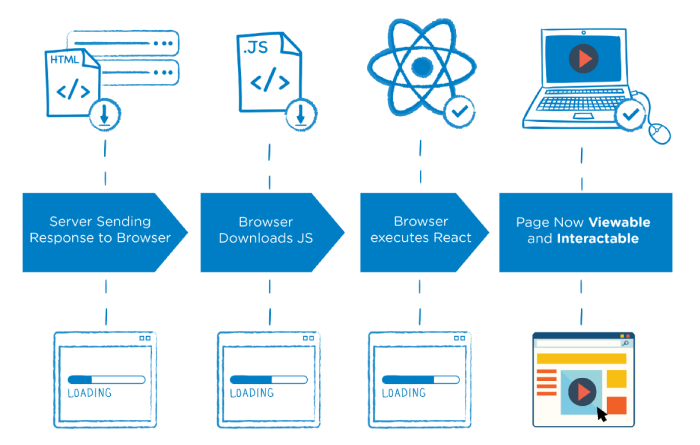
    When it comes to Client Side Rendering, JavaScript determines what is displayed on a web app’s page. The HTML documents in a CSR approach do not load all of the web content. Instead, there are JavaScript files that handle the website’s dynamic architecture. The CSR process mainly involves fetching and processing the data on the client browser. For that reason, it is called Client-Side Rendering.

    client side rendering - csr
    Image Source: Medium

    One great example can be a Single-page application (SPA). In a Single Page Application, each page is rendered on the client browser. The server only serves one single HTML document. Once the HTML is loaded, the JavaScript frameworks like React, Angular, or Vue will control the website’s DOM structure on the browser.

    In this case, each page will load from the data history as fetched by the framework’s API. Once the initial load is over, accessing a different route or reloading the page will be super fast.

    What actually happens in Client Side Rendering (CSR)

    • Using the website address, the user sends a request to access the web content via a browser (link).
    • On the client’s first request for the website, the server serves the static files (CSS and HTML) to the client’s browser.
    • The HTML content will be downloaded first, followed by JavaScript. JavaScript is linked by these HTML files.
    •  When the user sees the loading symbols defined by the web developer, the loading process begins. 
    • The user cannot yet access the site.
    • After the browser downloads the JavaScript, the client’s browser generates content dynamically.
    • Finally, the web content becomes visible and the client can interact and navigate the site.

    Pros of CSR

    • Hosting – For CSR, you don’t need a web server. You can simply host your site with any Content Delivery Network (CDN) that comes in both free and premium forms. You can also use a static file host (eg. Amazon S3).
    • Speed – After the initial loading time, navigation will be super smooth and blazingly fast.
    • Server load – Once the data fetching is done, you can roam around from page to page without making the server roundtrip. Thus, it decreases the server load. It almost feels like a native application.
    • Rendering – The rendering performance is dependent on the client’s browser capabilities. So, in terms of managing requests, the server will not be at risk.
    • Memory – CSR has lower memory consumption on the server side.

    Cons of CSR

    • Loading Time – The browser loads the initial run-time data of the website to the client’s browser that’s why it takes a lot of time.
    • User experience – Users can get frustrated because of this loading time and leave your site.
    • Site indexing – When search engine robots crawl on a website CSR slows them down. These robots crawl and index an HTML file page first. So, while indexing, the robots can miss or partially miss the JavaScript content.
    • SEO – If the robots partially or completely miss indexing the JavaScript content, it will affect the Search Engine Optimization (SEO).
    • Meta tag – There will be only a single meta tag for all pages.

    When to use CSR

    • Large user base – CSR fits well for a large user base who are continuously accessing your web content. The content will be rendered once for every user request.
    • Complex UI & more dynamic content – It can be a good option if your application has a complex UI & a ton of dynamic content that is not dependent on SEO.
    • Hybrid web app – For hybrid web apps, CSR is a good option.

    Server Side Rendering (SSR)

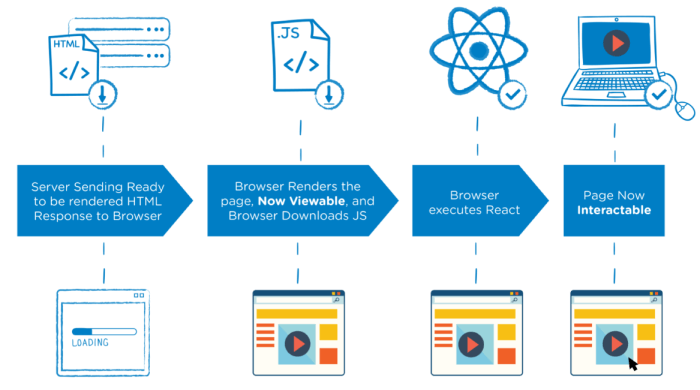
    SSR is the most commonly used rendering solution. It is the opposite of Client Side Rendering (CSR). With SSR, the rendering process is conducted via the server. For that reason, we call it Server Side Rendering. When a user makes a request to the server, the server process the HTML, CSS, and JavaScript files on-demand. It then delivers the full page to the end user’s browser.

    server side rendering - ssr
    Image Source: Medium

    On the other side, Client Side Rendering is nothing like Server Side Rendering. In SSR, every following time the user takes action to visit another page, the rendering process shoots off again. It repeats the process every time you request a page. So, the browser is constantly making requests to the server. Thus, it becomes a heavy burden on the server side.

    What actually happens in Server Side Rendering (SSR)

    • A user makes a request for a specific webpage.
    • Then the server prepares an HTML page. It is done by fetching user-specific data.
    • After that, it sends the HTML page to the user’s machine over the internet.
    • Following the path, the browser construes the content and displays the page.
    • Finally, the web content comes to visibility. And, the user can now interact and navigate through the page.

    Pros of SSR

    • SEO – In terms of SEO, SSR is a great rendering option. It is so because each of the pages will be rendered on the website’s server independently. Eventually, it will increase your web page’s performance. By that, you will get enhanced web content rankings.
    • Site indexing – With SSR, the search engine robots will not by any chance miss content as they exist before the user receives it. They will get higher relevancy as the page content are more focused. This way the bots will be making proper indexing.
    • Loading time – Initially, it will take less time to load.
    • User experience – The faster initial loading time will give your visitors the first interaction comfort. Which is one of the most important aspects of generating high traffic.
    • Meta tag – You can use different meta tags for different pages.

    Cons of SSR

    • Server Load – In the SSR approach, for each page requests the server will receive a new request. After that, it will load the newly requested page. This puts a lot of pressure on the server side. If there are too many users who made a ton of requests at once the server might end up making connection errors.
    • Memory – It has high memory usage and high processing power on the server side.
    • Hosting – The process consumes unnecessary internet bandwidth and increases the hosting cost.
    • Page Load – The server has to render dynamic content repeatedly for that reason it increases the page load time.

    When to use SSR

    • High SEO Ranking – As every web page content is served independently. It is a great chance to catch up with social crawlers to target a high SEO ranking.
    • Small user base – SSR has an overall slow rendering speed. Therefore, it is best to use the SSR approach when you have a small user base.
    • Simple UI & less dynamic content – It is good for simple UI, few pages, less interactivity, and also less dynamic content.

    Wrapping Up

    Here, we talked about Client Side Rendering vs Server Side Rendering. Both of the approaches are perfect and scalable. It depends a lot on the kind of web application you want to build. For example, the UI, features, number of pages, content type, SEO & loading time, etc. We hope you found the blog helpful in understanding and deciding which approach best fits your web content.

    Thank you for reading!

    About Us

    At UI-Lib, we develop high-quality free & premium templates, design systems, full solutions, and more. Thus, we’re all about delivering services that make coders’ lives easier.
    Blog Suggestions

  • Nextjs vs Nuxtjs: Which One Should You Use?

    Nextjs vs Nuxtjs: Which One Should You Use?

    Nowadays, every online business desires a high-quality web application. To help you achieve that in the shortest time period there are several excellent JavaScript frameworks available. Nextjs and Nuxtjs are two examples of them.  

    In this blog, we’ll compare Nextjs with Nuxtjs through introductory-level information. So, if you’re a beginner developer embarking on a new project, this guide will surely help you make the right decision.

    What is Nextjs?

    Nextjs is an open-source React framework built on top of Node.js. It is for building static websites and web applications that are highly flexible and user-friendly. Generally, it serves functionalities such as server-side-rendering and generating static websites for React.

    nextjs logo
    Next.js logo

    React’s documentation page lists Nextjs as one of the ‘Recommended Toolchains.’ They recommend Nextjs to developers as a solution while creating a ‘server-side-rendered website with Node.js.’ Nextjs has the functionality to include applications rendered on the server-side, while React apps only render the content in the client-side browser.

    Brief History

    Guillermo Rauch, the original author of Nextjs, released Next as an open-source project on GitHub. In 2016, Nextjs began its journey as a framework based on six principles. And now, over the last six years, it has evolved significantly and recently released its 12th version, Next.js 12.

    Six Principles of Next.js

    1. Out-of-the-box functionality requiring no setup
    2. JavaScript everywhere
    3. All functions are written in JavaScript
    4. Automatic code-splitting and server-rendering
    5. configurable data-fetching
    6. anticipating requests and simplifying deployment

    So, Here is a list of popular web applications built using Nextjs,

    • Netflix
    • Hulu
    • Invision
    • Uber
    • Starbucks
    • Docker
    • Twitch
    • Magic Leap

    Our NextJS-Based eCommerce CMS Full-Software 🎁

    biponi ecommerce full software

    Live Preview Details / Download

    What is Nuxtjs?

    Nuxtjs is also an open-source framework for web applications inspired by Nextjs. It is based on webpack, vue.js, node.js, and Babel.js. Also, the framework is known as a ‘meta-framework’ (for universal application) and aims in developing SEO-friendly web applications with reduced interactivity time.

    nuxtjs logo

    It can function both as ‘in-browser single page application views’ and also as ‘server-rendered web views’. This can be rehydrated to full SPA functionality. Moreover, it can fully pre-render the content (or parts of it) on the server. And, it served in the manner of static site generators.

    Another key advantage of Nuxt is that it simplifies and streamlines the configuration and setup of such applications for the application developer. Therefore, developers can develop UI portions of the application as if it were a more common single file Vuejs application.

    Brief History

    In comparison to the Next.js framework, Nuxt is comparatively less popular amongst developers. However, both Nextjs and Nuxtjs got launched in the same year (2016) on GitHub. The framework has three original authors, Alexandre Chopin, Sebastien Chopin, and Pooya Parsa. Now, there are over 300 contributors around the globe who are working on the project and it is going to launch its Version 3 in June 2022.

    Core Principles of Nuxt.js

    1. Out-of-the-box functionality requiring no setup
    2. JavaScript everywhere
    3. All functions are written in JavaScript
    4. Automatic code-splitting and server-rendering
    5. configurable data-fetching
    6. anticipating requests and simplifying deployment

    Popular Web Application Built With Nuxtjs

    Here is a list of popular web applications built using Nuxtjs,

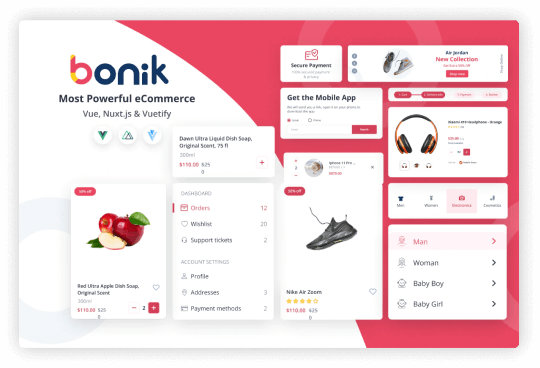
    Our Vue Nuxtjs-based Multipurpose eCommerce Template 🎁

    bonik vue nuxtjs vuetify ecommerce template

    Live Preview Details / Download

    Nextjs vs Nuxtjs: Key Features

    Next.js and Nuxt.js both have got some really useful features. Some of them are mentioned below.

    Nextjs Main Features

    Next.js has some eye-catching features that are very useful in getting highly efficient results. Here are some of the features mentioned below.

    • Data Fetching – Next.js allows you to render your content in a variety of ways, depending on the use case of your application.
    • Built-in CSS Support – With Nextjs you can import CSS files from a JavaScript file. Basically, this is possible because Next.js extends the concept of import beyond JavaScript.
    • SEO Friendly – Nextjs helps you to easily create titles and keywords for each page. You just have to use the featured head component to place them on every page.
    • ESLint Compatible – Next.js has included an integrated ESLint experience since version 11.0.0.
    • Image Optimization – Nextjs provides higher-quality, resized images in modern formats such as WebP. (Open to new formats). The images are also set up to adapt to smaller viewports.
    • Configurability – The Nextjs routing system is as easy as creating folders. It is highly configurable.
    • API support – Next.js connects APIs easily and helps you create your own API routes.
    • Typescript – Next.js supports the Typescript programming language.

    Nuxtjs Main Features

    Nuxtjs also has various features that are highly effective in terms of web application development and static site generation. Here are some of them.

    • Zero Configuration – Nuxt allows you to start making your project within seconds.
    • File System Routing – It allows automatic routing and code-splitting for every page.
    • Rendering Modes – With Nuxt it is simple to switch between static-site generation and on-demand server rendering.
    • Data Fetching – You can fetch your content from any source in your Vue components, SSR ready.
    • Strong Conventions – Nuxt has a strong directory structure and conventions which leads to highly efficient teamwork.
    • SEO Friendly – Nuxt has amazing meta tag management and faster time-to-content for great indexing.
    • Components Auto-import – It will import your components with smart code-splitting.
    • Modules Ecosystem – There are 160+ Nuxt modules with which you can extend your app. Also, you can create your own.

    Nextjs vs Nuxtjs: Common Features

    Nuxtjs launched from the inspiration of Nextjs. As a result, the following similarities can be found:

    • Data Fetching
    • SEO-Friendly
    • Zero Configuration
    • Server-Side Rendering
    • Static Site Generation
    • Requires Node.js Server
    • Javascript

    Drawbacks: Nextjs vs Nuxtjs

    Just like any other technology, both Nextjs and Nuxtjs have flaws too. Below are some of the drawbacks of each.

    Drawbacks of Nextjs

    • Although Next is a very powerful framework, however, it can overkill when developing a simple application.
    • It is essential that all data be loaded from both the client and the server.
    • Migrating a server-side application to Next is not easy, and it may be quite difficult depending on the project.

    Drawbacks of Nuxtjs

    • Nuxtjs has a smaller community, which means fewer resources and less extensive documentation.
    • If there is heavy traffic, it may put a strain on your server.
    • Nuxtjs lacks some really useful plug-ins or components in it.

    Tools Integration: Nextjs vs Nuxtjs

    What Tools Integrate with Nextjs?

    Here is the list of tools that you can integrate with Nextjs.

    • React
    • Material UI
    • Strapi
    • Sanity
    • Builder
    • DatoCMS
    • GraphCMS
    • Magnolia CMS
    • Tipe
    • Divjoy
    • Glamorous
    • Webiny headless CMS
    • Clerk
    • Pika Pack
    • Plasmic
    • Thin Backend
    • Moovweb XDN
    • Front Matter
    • Devsync
    • Panelbear
    • Tolgee

    What Tools Integrate with Nuxtjs?

    Here is the list of tools that you can integrate with Nuxtjs.

    • Strapi
    • Builder
    • DatoCMS
    • Localazy
    • Kentico Cloud
    • WindiCSS
    • Moovweb XDN
    • Devsync
    • Panelbear
    • Master Styles
    • BagelDB
    • Gravity Framework
    • Deploy Now
    • AutoAnimate
    • Agility CMS

    Nextjs vs Nuxtjs: Basic Information

    Next.jsNuxt.js
    Original Author(s)Guillermo RauchAlexandre Chopin, Sebastien Chopin, Pooya Parsa
    ServerNode.jsNode.js
    Initial ReleaseOctober 25, 2016October 26, 2016
    Stable Release12.1.0 / 17 February 20222.15.7 / 14 June 2021
    LicenseMIT LicenseMIT License
    RepositoryGitHubGitHub
    Written InJavaScript, TypeScript, and RustJavaScript
    PlatformWeb PlatformCross-Platform
    Size 79.46 KB57 KB
    TypeWeb Application FrameworkWeb Application Framework
    Testing ToolCypress, Playwright, Jest, VitestNuxt Test Utilities
    GitHub Stars87.2k40.6k
    GitHub Forks18.5k3.2k


    Source: Wikipedia & GitHub

    Wrapping Up

    Next, Nuxt and any other JavaScript-based approach are all pretty spectacular in terms of their respective use-cases. There is no clear winner in this type of situation. You’ll need to determine your use case and then match it to the features of these frameworks.

    Which do you plan to use for your next project — Nextjs vs Nuxtjs — and why? Evaluate now!

    Thank you for your time.

    About Us

    At UI-Lib, we develop high-quality free & premium templates, design systems, full solutions, and more. Thus, we’re all about delivering services that make coders’ lives easier.

    Blog Suggestions

  • Top 10+ VueJS Boilerplates That You Shouldn’t Miss in 2022

    Top 10+ VueJS Boilerplates That You Shouldn’t Miss in 2022

    Are you looking for VueJS boilerplates? The best ones are right here. Today, we will be showcasing to you some of the best Vue boilerplates that you should not overlook in 2022.

    Boilerplates are an excellent solution to jump-start your project quickly. And, you can keep your focus on the most important aspects. The use of boilerplates in association with reusable common components speeds up development. In many circumstances, it results better and provides more maintainable code.

    You can use technologies like Bit to accelerate development. It allows you to “harvest” reusable Vue components from any codebase. After that distribute them with a bit.dev component collection. It is a great method to increase code reuse (both within and between repos) and improve team cooperation.

    To learn more about Boilerplates, their benefits, usability, multiple comparisons, and differences, click HERE.

    We have a gift for you. 🎁

    free vueJS tailwindcss admin template

    VueJS Boilerplates

    So, here are our top picks for the best VueJS boilerplates.

    1. Vue WordPress

    Vue.wordpress is a boilerplate for creating Single Page Applications (SPA) with the WordPress REST API and Vue.js. It is performance-optimized. Moreover, it allows for better SEO with server-side rendered pages and content. It has a SPA-like front-end and manages back-end content with WordPress and the WP Rest API.

    Currently, it has 400+ GitHub Stars and 100+ Forks. With the boilerplate, you will find extensive documentation and its front and backend work on the same host. Furthermore, it supports client/server code partitioning, adding Hot Module replacement, libraries like Axios, Vue.js, Vuex, Vue Router, and more.

    GitHub

    2. Vuesion

    For a Progressive Web App (PWA), Vuesion is an amazing option. It is a PWA boilerplate that is ready for production. The boilerplate is very simple to install using npx or npm. Also, it focuses on best practices during the development and production phases. Now, it has 2k GitHub stars, 350+ Forks, and a live Heroku demo.

    Vuesion contains features like instant display of UI changes, proper documentation, preserved application state while updating code, and enabling scaffolding. Enables Mock APIs and tests for individual components.

    GitHub

    3. Vue Enterprise Boilerplate

    Created by Chris Fritz (Vue’s Core team member), this boilerplate is only for enterprise-level applications projects. The boilerplate contains well-defined layers (for larger applications), testing practices, customizability, an in-built generator, proper documentation, support linters & TDD.

    Also, it describes the troubleshooting tips for common issues during development. And now, with 7.5k GitHub Stars and 1.3k Forks, the Vue Enterprise Boilerplate is one of the most popular boilerplates for Vuejs on the internet.

    GitHub

    4. Nw.js + Vue.CLI

    Nw.js is a desktop application framework that uses HTML, CSS, and Java to create applications. It is made with Chromium and Node.js. Install the Vue.cli and add the NW.js dependencies and SDK to your Vue project to build Vue applications. It has 70 GitHub stars and is a Vue application boilerplate for beginners.

    GitHub

    5. Vuetify

    Vuetify is a tool for making your Vue projects more visually appealing. It has been inactive development since 2016, with more than 34k Github Stars, 6k+ Forks, and generous contributions. Also, It has a large number of Github sponsors. Most importantly it reduces the design effort for Vue projects.

    GitHub

    It has features such as proper documentation, supports protected binaries, customizing stylings, and easy customization.

    6. Electron Nuxt – Boilerplate

    The Electron Nuxt boilerplate enables you to create web-like desktop apps. Applications like Slack, Discord and Microsoft Visual Studio use this feature. Here, you will find features like an auto-updating boilerplate. And, it supports typescript in the rendering process, parallel code compilation, CSS preprocessor, etc. There are different testing supports like unit-testing, end-to-end testing, and a lot more.

    The boilerplate currently has 600+ GitHub Stars and 70+ Forks.

    GitHub

    7. Electron Vue – Boilerplate

    Electron Vue is a free and open-source library for creating cross-platform desktop applications. It creates single-runtime apps with Chromium and Node.js. The application is compatible with a variety of operating systems such as Mac, Windows, and Linux.

    This boilerplate is widely popular and now has almost 15k GitHub starting with 1.6 Forks. It uses Vue CLI for scaffolding, setup starts with a single package.json file, and utilizes ready-made Vue plugins. And, it uses Babili and supports linting using ESLint.

    GitHub

    8. Vue Express Mongo Boilerplate

    Vue Express Mongo Boilerplate is a full-stack “MEVN” web app boilerplate. It includes user signup and social login with Google, Facebook, Twitter, and GitHub.

    Moreover, this boilerplate adheres to best practices in security by utilizing OAuth 2, Helmet (which adds secure HTTP headers). Also, it uses Express Validator for input sanitization. It supports a number of remote logging services.

    GitHub

    9. Vuexpresso – Vue Boilerplate

    Vuexpresso uses GraphQL, Apollo, and GraphiQL UI (an in-browser IDE for exploring GraphQL). In addition, you get a fantastic Webpack setup, Vuex, and Vue Router. You will also receive Storybook, which enables interactive development, testing, and sharing of UI components.
    There have been no new updates in the last two years. It currently has 400+ GitHub Stars and 70+ Forks.

    GitHub

    10. Mevn-CLI – Vue Boilerplate

    Mevn-CLI is compatible with the MEVN stack. MEVN is an acronym that stands for MongoDB, Express.js, VueJS, and Node.js. This boilerplate provides a quick start for MEVN stack-based web apps by installing a local environment automatically. Now, this project has 700+ Github stars and 140+ Forks.

    Among some of the essential features, the MEVN stack is built using a set of commands and additional utilities, uses developer-friendly ES6 syntax, creates boilerplate code, and automates repetitive tasks.

    GitHub

    11. Vue Skeleton

    Vue Skeleton MVP lets you build Vue applications with Vue.js, Vuetify, Vue router, and Vue skeleton. It is written in Javascript and uses the async/await function. It has 450+ Github Stars. Also, a link to a demo application. Importantly, it features include providing a basic template for a quick start.

    GitHub

    Wrapping Up

    Finally, it appears that your search for essential Vue boilerplates is over. It is hard to pick the correct Vue boilerplate, especially for scaling, future maintenance of the app or website, and customizations. Therefore, you gave you some of the best boilerplates you can rely on. However, make sure to check every detail before choosing one. See if it fulfills your project requirements. With your next Vue-based project, we wish you the best of luck.
    Thank you for your time!

    Blog Suggestions

  • Top 10 Best NuxtJS Templates in 2022

    Top 10 Best NuxtJS Templates in 2022

    Are you a developer looking for some of the Best NuxtJS Templates available on the internet? Don’t worry! In this blog post, we will be showcasing the Top 10 Best NuxtJS Templates in 2022.

    The NuxtJS framework is for creating VueJS applications. Its goal is to provide developers with a faster, smoother, and more organized way to develop and take advantage of great and advanced technologies.

    Web applications require social sharing features and management. In this case, NuxtJS offers great SEO factors, especially, meta tag managing. With Nuxt, you can create specific & customizable social share windows and will be able to depend on the data that you get from the backend.

    Therefore, in today’s blog, we’re offering some of the best free and premium NuxtJS templates that you will love to have on your checklist before start creating your Nuxt-based project.

    Top Nuxt JS Templates

    1. Bonik- Ultimate Vue NuxtJS eCommerce Pro

    Bonik Vue Nuxt eCommerce Template

    Bonik is a multipurpose eCommerce template by UI-Lib. It offers you a unique design template that has multiple home pages along with a ton of features. With Bonik, you can create a blazingly fast, server-side rendered, and mobile-friendly eCommerce site.

    More importantly, the template offers easy customization options with clean code, proper documentation, vendor account, user account, lazy loading, Apexchart, slick carousel, and Figma files. Therefore, you will have everything that could take months of hard work before you even start your actual business.

    Key Features

    • Full Nuxtjs Version
    • Full Vuejs Version
    • Blazing Fast
    • Multiple Home pages
    • Optimized for mobile & performance
    • Admin/vendor dashboard
    • Multi-vendor support
    • User account dashboard
    • Fully responsive design
    • Lazy image loading
    • Powered by Nuxt.js
    • Apexchart
    • SEO friendly
    • Clean Code
    • Server-Side Rendered
    • Easy to customize
    • Figma Ready
    • Slick Carousel library

    and more.

    Details / Demo / Download

    2. Riode – Vue NuxtJS eCommerce Template

    Riode - Vue NuxtJS eCommerce Template

    Riode is another Vue NuxtJS ultimate eCommerce solution with useful features and tools. The template is built with Vue.js, Nuxt.js, VueX, and SCSS. There are more than 20+ demo layouts with all trending design elements with stunning UI UX experience. It allows you to cut your design costs in half and create a super responsive storefront.

    Details / Demo / Download

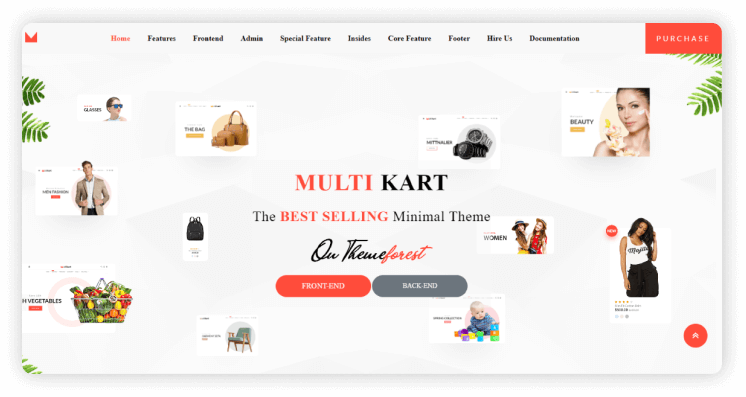
    3. Multikart – Responsive Vue Nuxtjs eCommerce Template

    Multikart Vue NuxtJS eCommerce Template

    Multikart is a Vue Nuxtjs template with multiple uses. It is here for you to complement multi-purpose websites. It will guide you to efficiently run numerous eCommerce businesses at the same time. 

    Specifically, the template is for any type of online store: clothing, mobile, bags, shoes, accessories, fashion, and so on. Moreover, the template includes Saas support, Paypal gateway, stripe.js checkout, more than 10 color options, multiple currency options, translation options, and a lot more.

    Details / Demo / Download

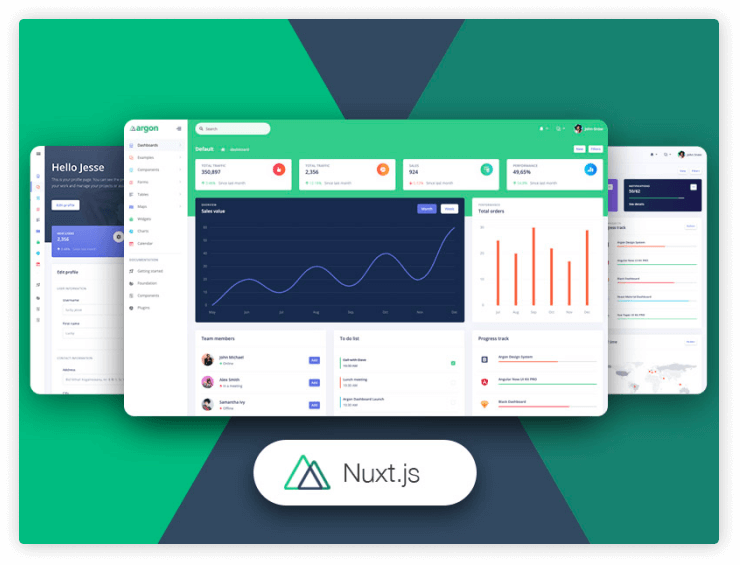
    4. Nuxt Argon Dashboard PRO

    Nuxt Argon Dashboard

    Nuxt Argon Dashboard PRO improves the product’s usability, adaptability, and customization. It will amaze you with its excellent features and build tools, taking your project to a new level.

    The template is made up of over 200 individual components. This gives you the option of selecting and combining items. Furthermore, the components can have color variations. As a result, the Sass files can be easily modified. Also here, you can save a significant amount of time transitioning from prototyping to full-functional code.

    Details / Demo / Download

    5. Nuxt Now UI Kit PRO

    Nuxt UI Kit Pro

    Nuxt Now UI Kit Pro is a Bootstrap 4 responsive theme. It is a cross-platform UI kit that includes 11 templates and over 1000 elements. The template also includes PSD and Sketch file formats. Moreover, it will also assist you in creating a clean and simple website that is a perfect fit for today’s flat design.

    The 12-column grid system is used to construct the template. It also makes use of bright colors, beautiful typography, clear photography, and open layouts.

    Details / Demo / Download

    6. Nuxt Black Dashboard PRO – Nuxt JS Template

    Nuxt Black Dashboard Pro

    Nuxt Black Dashboard PRO is an Admin Dashboard with two modes: Dark and Light. If you need a tool to manage and visualize data about your business, this dashboard is for you. It combines eye-catching colors, large cards, beautiful typography, and graphics.

    Furthermore, it combines a number of components and plugins. There are several example pages here that will serve as inspiration.

    Details / Demo / Download

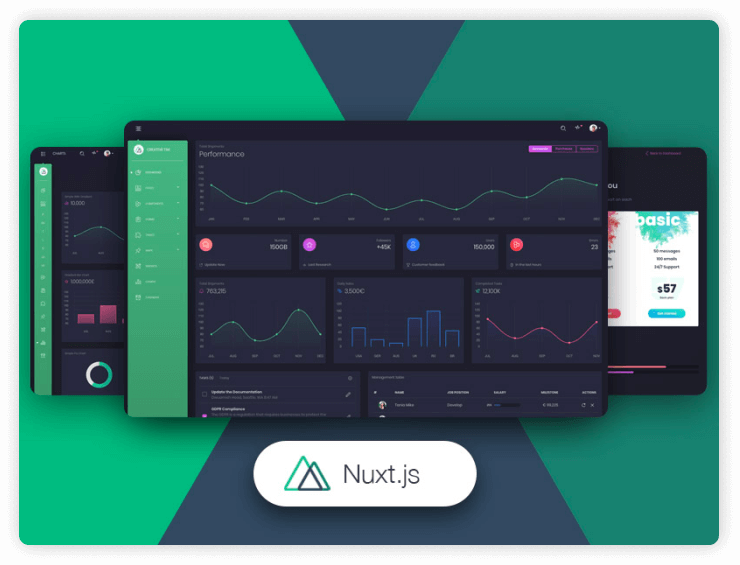
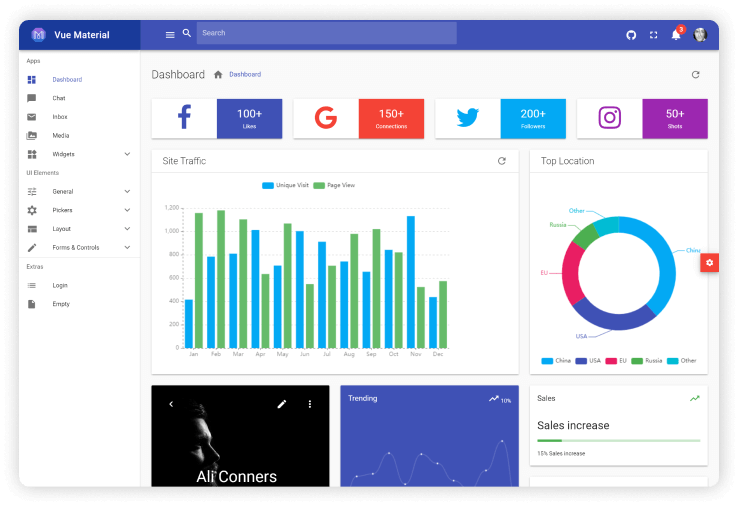
    7. Nuxt Material Admin Template

    Nuxt Material Dashboard Template

    With the Nuxt Material Admin template, you will have no trouble capturing your site visitors’ attention and piquing their interest in the services you provide. It is a Vue-CLI Boilerplate with Nuxt and vue-material-admin templates.

    Details / Demo / Download

    8. Brook – VueJS NuxtJS Template

    Brook VueJS NuxtJS Template

    Brook is a multipurpose Vue Nuxt JS template that is both powerful and creative. There are over 25 beautiful home pages. You can also use any template or mix content from various home pages for your website.

    Most importantly, it is a versatile Vue NuxtJS Template that can be used for a variety of purposes. It emphasizes site-building creativity, efficiency, and diversity. Your project will be a sharp weapon for businesses to dominate in online branding and marketing with the template.

    Details / Demo / Download

    9. Nuxt Scutum Dashboard Template

    Nuxt Scutum Dashboard

    Scutum Admin is a high-quality HTML5/CSS3 Material Design template built on the UIkit Framework (v3). This Vue template version can assist you in developing any backend application. For instance, shop backend, analytics backend, CMS, CRM, and so on.

    Details / Demo / Download

    10. Mitech – VueJS NuxtJS Technology & Blog Template

    mitch nuxtjs vuejs tech blog template

    Mitech – An exclusive Vue NuxtJS web template for IT solutions and services companies. There are over six demos for various purposes. Also, you can easily use this vuejs digital software template for an amazing result.

    Moreover, the template has six homepage variations. And, it includes over 9 technological case study layouts. Also, here you will find six stunning and eye-catching header styles. It will keep updating. And guess what! You will receive all the updates completely free.

    Details / Demo / Download

    Conclusion

    Finally, it appears that your search for the best NuxtJS Templates has ended. Nuxt js has a long history, a large community, and consistent growth and development. The framework has both obvious advantages, such as different types of rendering, and obvious disadvantages, such as being highly opinionated.

    We discovered that Nuxt JS is appropriate for building small applications with several pages, or medium-sized applications with a relatively simple architecture, which appears to be possible to think through completely before beginning to write.

    Thank you for your time.