Tag: React

  • Best Typescript React Admin Template 2024

    Best Typescript React Admin Template 2024

    Are you looking for some responsive Typescript React Admin Templates for your next project? Congratulations! 😁 You’ve found the right blog post. Here, you will find all the latest developer-friendly, and highly customizable, up-to-date TypeScript React admin templates.

    Here’s a gift for you from UI-Lib! A Free React Admin Template with All the Premium Features 👇🥳

    Top TypeScript React Admin Templates

    Please keep in mind, that the list below is in no particular order. Choose any TypeScript React Admin Templates you prefer from below. But, choose wisely. If you want to level up your admin template buying skills, quickly go through this link below, and learn how to choose an admin template in 5 simple steps.

    👉How To Choose An Admin Template (In 5 Simple Steps)

    Without further ado! Let’s find out the best & latest TypeScript React Admin Templates 2022.

    1. Onion – React CRA/Vite/Next.js UI Kit

    • Next.js app routing
    • Create react app and Vite version
    • JWT/Firebase/Auth0/Amplify authentications
    • Formik forms
    • Dark/Light themes
    • i18next
    • Right to left supported
    • Datatables (MUI & React table)
    • Analytics, CRM, ecommerce, Logistics, Marketing etc. dashboards
    • Fully customizable
    • Responsive for all devices
    • Figma design file with figma variable mode switch feature (Only available with Plus and Extended license)

    Details / Download Live Preview

    2. Sash – React TypeScript Admin & Dashboard Template
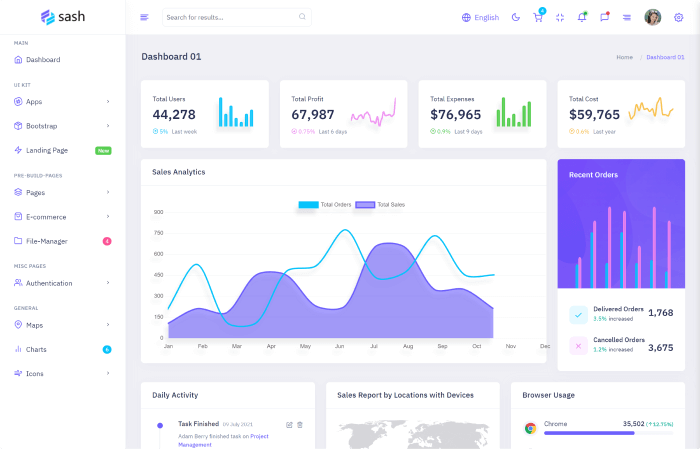
    Sash - React TypeScript Admin & Dashboard Template

    Sash is a React Typescript Admin Dashboard Template. Also, it is among the most developer-friendly & adaptable templates available! To create this incredible template, the developers employed React and Bootstrap. It offers all the helpful features, including a horizontal menu, LTR, and RTL, as well as light and dark colors. Moreover, it features a fully responsive design and react-styled components. Besides that, with react elements, you can quickly design any type of React gateway.

    Details / Download Live Preview

    3. Tokyo – Free React TypeScript White Admin Dashboard
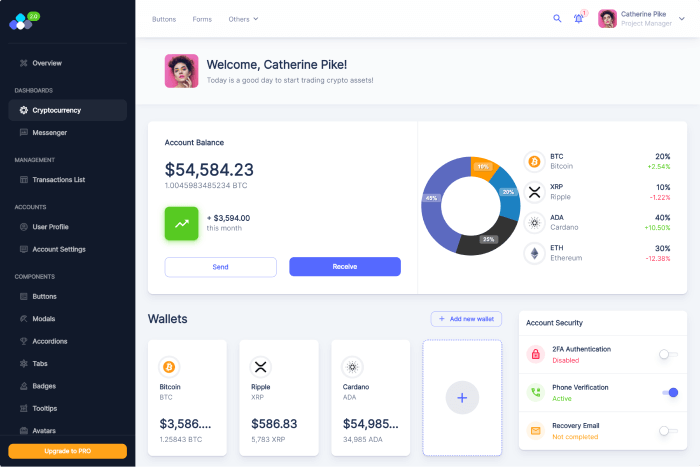
    Tokyo - Free React TypeScript White Admin Dashboard

    Tokyo is a free and open-source Material UI Typescript React admin template. It has a light and clean color scheme. You can rapidly change the color scheme and design by altering specific variable files. Here, you will find the messenger application, card examples, dynamic tables, and responsiveness. Furthermore, you can implement it with simple changes to your projects. Its appealing design and clean codes make it an ideal admin template for web developers.

    Details / Download Live Preview

    4. Inst – TypeScript React Admin Template with GraphQL
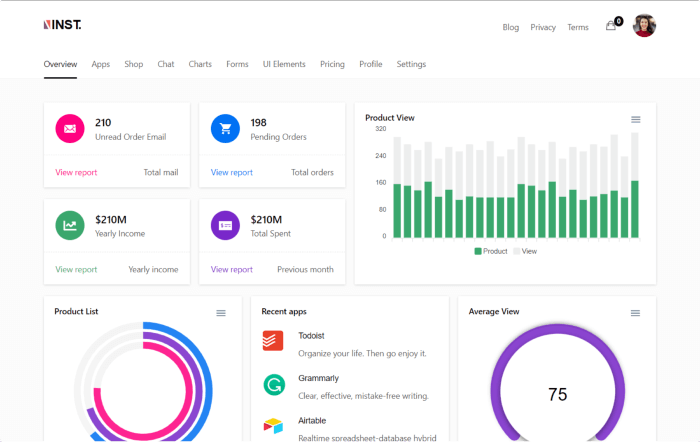
    Inst - TypeScript React Admin Template with GraphQL

    Inst – An Admin Template with React, NextJS, TypeScript, GraphQL, and Uber’s Base UI. It is one of those lovely minimalist React dashboards. Here, they’ve utilized GraphQL with type-graphql, and it is simple to use. Besides, they’ve utilized this progressive web application pattern and well optimized it for your upcoming react application project. You can use it for your web apps’ Dashboard and Public pages. Also, it has both the Light and Dark modes available.

    Details / Download Live Preview

    5. Materially ReactJS TypeScript Admin Dashboard – Free & Premium
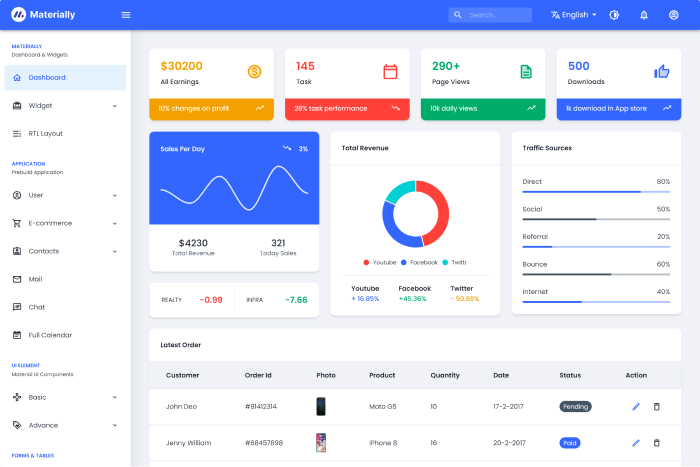
    Materially ReactJS TypeScript Admin Dashboard - Free & Premium

    Materially – A modern UI with the greatest design sets and development structure for your next admin project. It has a plethora of layouts and selection options. Besides, it will save your precious time and page thoughts from suffering for hours with its finest design standards. 

    The template has App Pages and Components you can use on any site. To provide you with the finest site experience. The template has great code quality without sacrificing the design. It has high ratings from Google Page Speed, Pingdom, and GTMetrix as well. Moreover, it offers a variety of widget options, chart icon selections, and other super useful features.

    Details / Download Live Preview

    6. Able Pro Bootstrap 5, Angular 13 & React Admin Template
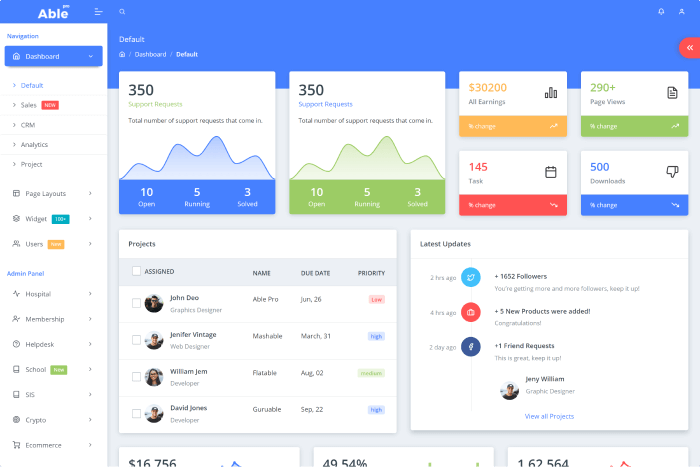
    Able Pro

    Able Pro is a Typescript admin template built on React. It has ready-to-use features that accelerate and simplify the development process. Furthermore, the well-structured & code makes the development of your project easier.

    Also, the design of this React Bootstrap admin template looks excellent on all devices. More than 150 ready-to-use widgets are included in Able Pro, making it simple to create any application. Besides, it has every fundamental element, like Alert, Breadcrumbs, Button, Box-shadow, Accordion, Generic class, Tabs, color, Label Badge, and many others.

    Details / Download Live Preview

    7. AppStack
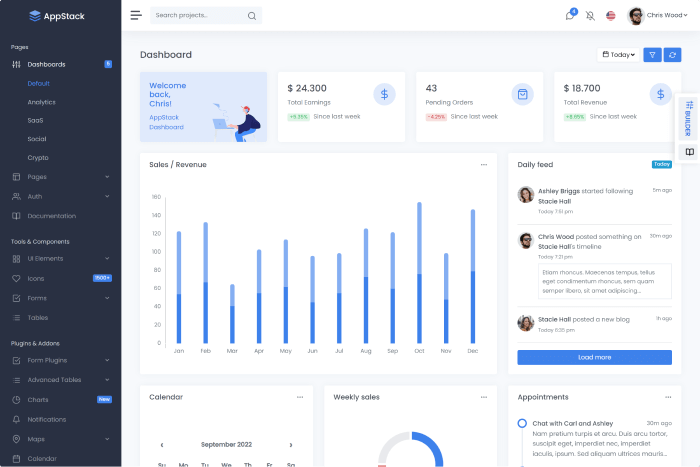
    AppStack - TypeScript React Admin Template

    AppStack is yet another responsive Bootstrap 5 React TypeScript admin dashboard template for anyone looking to develop online applications that are both quick and effective. It enables you to produce your subsequent Bootstrap even more quickly than previously.

    Besides, it provides over 45 pages, full responsiveness, four color schemes, a dark theme alongside the standard light version, the ability to customize with SCSS Variables, and much more. You can use it to build anything you want on the web, including a SaaS-based interface and dashboard. Your team will move more quickly and spend less on development thanks to AppStack!

    Details / Download Live Preview

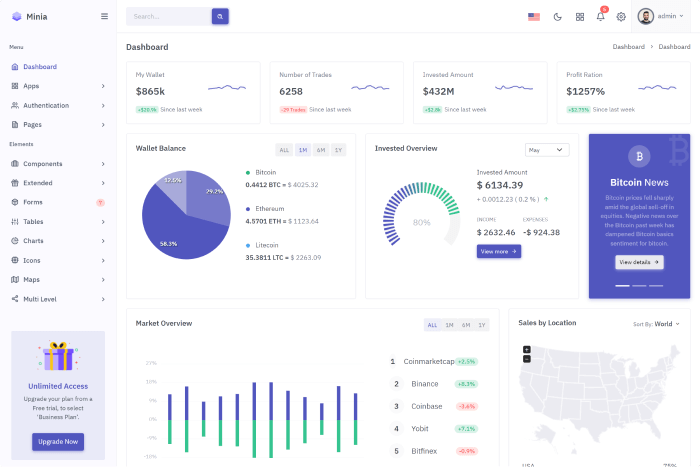
    8. Minia
    Minia

    Minia is a simple and elegant admin template with the latest versions of Bootstrap and React, and TypeScript. It contains more than six alternative layouts and three modes (Dark, Light, and RTL).

    You can easily change any layouts or modes by modifying a few lines of code. Besides, you may rapidly start small and large projects using the template or adjust the design of an existing project. It will undoubtedly provide a better user experience.

    Details / Download Live Preview

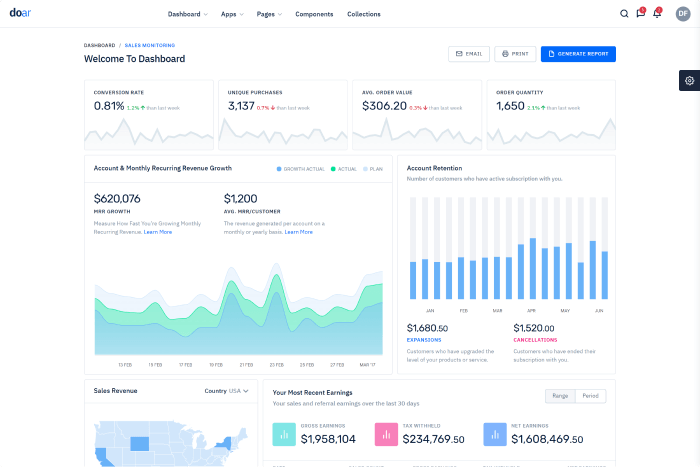
    9. Doar
    Doar

    If you are a react developer or the owner of a React website that needs to operate within a dashboard UI, then Doar is a good option. Doar is a responsive React Admin Template with TypeScript. Also, it offers you great possibilities, including four or more dashboards, the Lerna Monorepo Architecture, flat design, reusable components, maps, tables, charts, and more. It has a ton of material available to help you get a quick result that will draw attention.

    Details / Download Live Preview

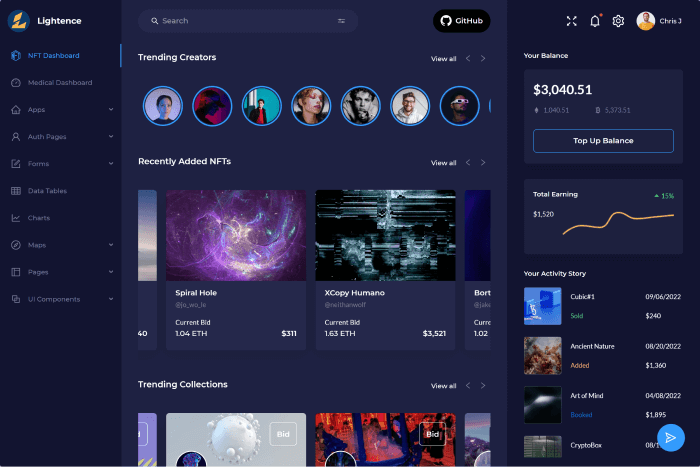
    10. Lightence – Free Ant Design React TypeScript Admin Template
    Lightence - Free Ant Design React TypeScript Admin Template

    Lightence is a free and open-source Typescript admin template for React. The template is simple to use and easy to integrate with any backend. Guess what! It is a responsive design. And it offers more than 60 NFT UI components, custom pages, built-in apps, light & dark mode, etc. Moreover, it boasts a striking theming style with light and dark versions. Additionally, thanks to its built-in dashboards for the medical and NFT industries, you may use it to construct modern and imaginative projects.

    Details / Download Live Preview

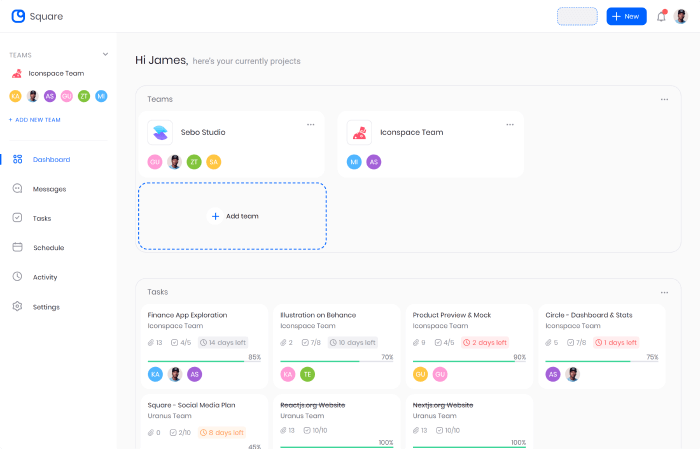
    11. Square – React TypeScript Dashboard
    Square - React TypeScript Dashboard

    Square is an open-source admin template with React, React Router, Redux, TypeScript, and Styled components. The admin template has a unique design and a contemporary color scheme. Besides, it supports drag & drop in several pages and the dashboard. The template features cross-browser compatibility and is simple to alter.

    Details / Download Live Preview

    12. React Material Admin
    React Material Admin

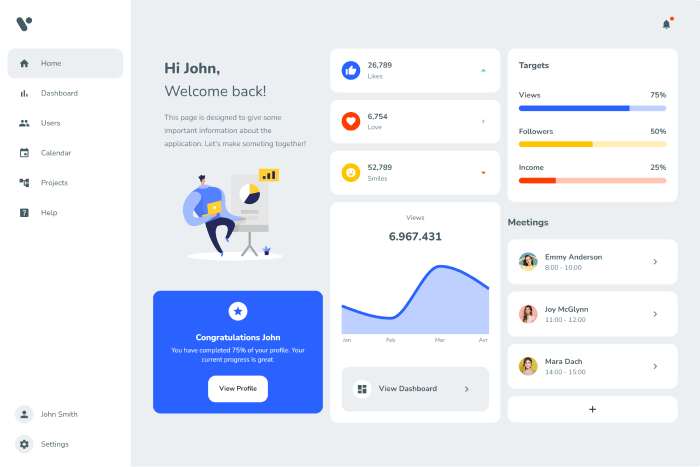
    React Material admin – an open-source admin template built on MUI components.  Moreover, it is a very adaptable admin template that is developer-friendly. Besides that, it offers code splitting, which enables you to “lazy-load” and enhances the functionality of your program. A complete set of UI tools are now available with the addition of MUI.

    Details / Download Live Preview

    Similar Articles

  • 15 General React JS Interview Questions To Land Your Next Job in 2022

    15 General React JS Interview Questions To Land Your Next Job in 2022

    We have selected all of the general React JS interview questions you should know as a beginner/intermediate in 2022. Whether you are interviewing for a hired position or not, you must know all of these questions’ answers.

    developer coding and preparing for an interview

    These general React js interview questions cover everything from core React concepts to the practical application of certain features. To get the best results from this guide, try to answer each question before looking at the answers.

    1. What is React JS?

    React js logo

    React.js is a JavaScript library for UI development (Front-end). The library is open-source, developed by Meta (Facebook), and helps make great UI based on UI components. Its original author is John Walke, launched on May 29, 2013.

    It’s a widely known library among the front-end industries for better quality web development. Besides, React offers extensions for entire application architectural support, such as Flux and React Native, beyond mere UI.

    2. What are the features of React? 

    The React framework is quickly becoming the most popular framework among web developers. Its  key features are as follows:

    • JSX
    • Components
    • One-way Data Binding
    • Virtual DOM
    • Simplicity
    • Performance

    Learn more about the features HERE.

    3. What are the Major Advantages of React JS?

    Some of React’s key advantages include:

    1. It improves the performance of the application.

    2. It can be conveniently used on the client as well as server-side.

    3. Because of JSX, code’s readability increases.

    4. React is easy to integrate with other frameworks like Meteor, Angular, etc.

    5. Using React, writing UI test cases becomes extremely easy.

    4. What are the Major Disadvantages or Limitations of React JS?

    The following are React’s limitations:

    1. React is not a full-blown framework, only a library.

    2. Its library is very large and takes a lot of time to understand.

    3. It can be a little difficult for novice programmers to understand.

    4. Coding gets complex as it uses inline templating and JSX.

    5. Real DOM vs Virtual DOM

    Real DOM Virtual DOM
    1. It update process happens slowly.1. It update process happens faster.
    2. HTML can be directly updated.2. HTML can’t be directly updated.
    3. Creates a new DOM if the element updates.3. Updates the JSX if element updates.
    4. The cost of DOM manipulation is high.4. Easy to manipulate the DOM.
    5. Excessive memory wastage.5. No memory wastage.

    6. What is JSX?

    JavaScript XML is known as JSX. It is a React-specific file type that combines the expressiveness of JavaScript with HTML-like template syntax. It makes the HTML file extremely simple to comprehend. This file strengthens applications and improves their performance. Here’s an example of JSX:

    render(){
        return(        
              
    <div>
                 
    <h1> Hello World from UI-Lib!!</h1>
     
             </div>
     
        );
    }

    7. What is the purpose of render() in React JS?

    Each React component must have a render(). It returns a single React element containing the native DOM component’s representation. If more than one HTML element needs rendering, You must group them within one enclosing tag, like a form, group, div, etc. The function must need to be in a pure state. And this function must be kept pure. So, it must return the same result whenever getting a call.

    8. What is the Difference Between State and Props?

    The State is a component’s local state, which cannot be accessed or modified outside of the component. It is the functional equivalent of local variables. Directly in opposition, props enable components to accept data from their parent component in the form of Props, making them reusable.

    9. What is an Event in React?

    An event in React is a type of action that you can trigger either a user action or a system-generated event. Events include mouse clicks, web page loading, key presses, window resizing, scrolling, and other interactions.

    For example:

    // For class component
    <button type="button" onClick={this.changeName} >Change Name</button>
    
    // For function component
    <button type="button" onClick={changeName} >Change Name</button>

    10. What is Redux?

    The open-source Redux JavaScript library was developed by Dan Abramov and Andrew Clark. For controlling and centralizing the application state, it was developed in 2015. When creating user interfaces, frameworks like React and Angular frequently employ Redux.
    The library makes it simpler to manage, predict, time-travel debug, and centralize application states.

    Simply, it gives you the ability to develop easy-to-test apps that function reliably across client, server, and native platforms.

    11. What are React Hooks?

    React Hooks are a specific category of function for connecting function components to React state and life cycle features. It has built-in hooks. Built-in hooks like useEffect, useState, useReducer, useRef, etc. Also, it allows you to create custom hooks.

    12. What are Custom Hooks?

    React Hooks, as you may know, allows you to create Custom Hooks; it is simply a mechanism for reusing stateful logic. Custom Hooks, for example, allows you to set up a subscription and remember the current value. This allows you to create cleaner functional components, remove logic from functional components, and avoid code duplication. You can avoid code duplication by reusing hooks for common use cases.

    Learn more about custom hooks from HERE.

    13. In React, What is Context?

    By enabling data to be sent down and used (consumed) in whichever component we require in our React application without the usage of props, Context is meant to share “global” data for a tree of React components. We can more easily transfer data (state) amongst our components thanks to it.

    14. Element vs Component in React

    A React component essentially explains what you need to see on the screen. Not surprisingly, a React element is a critical representation of some UI.

    A method or class that alternately acknowledges input and returns a React component is known as a React component. Ordinarily, through JSX, that gets transpiled to a createElement invocation.

    15. What is React Router?

    React Router is a routing library (Standard) for React. It is a simple API with powerful features like lazy loading, dynamic route matching, and location transition handling. And it is compatible with all platforms that support React, including web, node.js servers, and React Native.

    If you want to install this library into your React project, just follow the command, and that will do.

    npm install – -save react-router-dom

    Parting Thoughts

    These are the most common React JS interview questions. These are the general ones that are most common among companies that hire entry-level React developers. We hope these React JS interview questions help you get a little bit closer to your interview round selection. Best wishes for your upcoming job interview!

    Blog Suggestions

  • 10 React Boilerplates You Should Not Miss in 2022

    10 React Boilerplates You Should Not Miss in 2022

    Are you looking for React boilerplates? You’ll find all the great ones here. In this blog, we will learn and find out all the major React boilerplates that you should not miss in 2022. But first, for those who are unfamiliar with boilerplates, let us clarify a few points before diving into the best ones.

    react boilerplates

    What is a boilerplate?

    A boilerplate has nothing to do with a boiler or plate. Rather, it is a chunk of code that we can reuse a lot of times to repeat the process in particular sections. According to Wikipedia, “boilerplate is a section of code that is used interchangeably to provide this or that function”. Since developers go through a lot of code writing, boilerplate code saves their time and gives comfort.

    To reap the benefits of a boilerplate, clone it in Git for your project’s needs. After that, use a hot reloading function to refresh code changes.

    Difference between boilerplates & Starter kits

    These are not well-defined terms. These terms are frequently used interchangeably. However, in our opinion, the Starter Kit is a larger package that is used only once per project, similar to the code generated by create-react-app. Whereas boilerplate is used for smaller tasks such as the files we create for a single redux action or component.

    Rect boilerplate vs React boilerplate template

    React BoilerplateReact Boilerplate Template
    1. Open-Source development tool.1. Free / Open-Source / Paid development tool.
    2. Reduces the developing time.2. Reduces the developing time.
    3. Reusable parts of code.3. Case Frame / Layout
    4. Piece of writing, actual text, and images.4. Parts/features like a CSS style sheet, color palette, etc.

    Best React boilerplate?

    Because developers’ preferences differ, there is no such thing as the best react boilerplate. You may have them based on their popularity but not any other way. Each boilerplate is useful for resolving various tasks. The topic is very similar to asking anyone which JS library is best for front-end development. React developers would vote for React, and Vue developers would defend Vue. Simple as that.

    Evaluation Points

    • Clean code structure 
    • Code splitting
    • Comments presence
    • Well documentation
    • Responsive navigation system
    • Server and client code for setup
    • Scalability
    • Easy testing tools
    • Support & maintaining options

    Benefits

    The most important benefits of using boilerplates are time savings and a short learning curve. Simply incorporating a code template rather than writing everything from scratch saves time. Furthermore, thanks to a specific frame scaffolding code, the designer may be able to see the code more clearly in the future.

    However, every good thing has a drawback, so be aware that the downside of ready-made coding tools may be additional code maintenance and the need to navigate someone else’s code. Also, boilerplate commands may dump configuration information in the form of code. You’ll have to manually resolve bug lists, clean up a lot of code, and update the dependencies from the original repository.

    When to use React boilerplate?

    The use of React boilerplate depends on the size of your project. It is best to use boilerplates for light and responsive web apps. For long-term and time-consuming sites, it’s better to put effort into deep learning, DevOps toolchain, etc.

    To be honest, there are a couple of hundred React boilerplates available on GitHub. So, for choosing a particular one or a few, you need to have a clear goal. For example, you will build an app using React, TypeScript, Redux, etc.

    We’ve carefully handpicked 15 React boilerplates for different purposes. Please keep reading to unveil these great React boilerplates!

    10 React Boilerplates

    The list is in no particular order.

    1. Gatsby Static

    Gatsby is a fantastic boilerplate for building static websites or apps in React.js that are optimized for speed. It’s the ideal open-source framework for creating, say, a company’s e-commerce store. It has a starter kit gallery and provides the fastest outputs pre-rendered HTML and CSS to ensure the quickest load time. Learn about Gatsby with the official guide and a gallery of starter kits.

    GitHub

    2. React Redux Universal

    React Redux Universal is a boilerplate that includes react-router, redux, saga, webpack 3, jest with coverage, and enzyme. Its functionality allows you to perform actions on both the server and client sides. Redux eliminates boilerplate code and enables hot–reloading in the first place. Redux is suitable for multiple UI layers and has a robust ecosystem of addons to choose from.

    GitHub

    3. Electron React boilerplate

    To begin with, the Electron boilerplate has multiple entry points and a well-deserved reputation among coders, with 18.7k stars on GitHub. The three pillars of this boilerplate are hot reloading, incremental typing, and high code performance. Second, Electron allows you to switch between apps without having to refresh the page. It is compatible with electron-builder, TypeScript, eslint, webpack, and Babel.

    GitHub

    4. React Slingshot

    One more efficient tool to equip your React app is react-slingshot. It is a starter kit / boilerplate with Babel, hot reloading, testing, lining, and a working example app built-in. Its advantages are the only npm start command to get started through any modern browser. It works with a bunch of common technologies like SASS, ESLint, React, Redux, React Router, and others. Make the fast and highly automated production build – by typing npm run build. Available for macOS, Linux, and Windows as well. Currently, it has 9.8k GitHub stars.

    GitHub

    5. ny times kyt 

    Every large JavaScript web app requires a common foundation: a configuration to build, run, test, and lint your code. kyt is a toolkit that encapsulates and manages web app configuration. kyt has a wide range of applications in programming and can be used as a dependency in any project. It’s a useful tool for creating dynamic web applications in Node.js.

    GitHub

    6. React boilerplate

    With 28.2k stars on GitHub, React boilerplate is a solid and well-thought-out boilerplate in the Javascript UI Libraries. What’s on the inside? Redux, Mocha, Redux-Saga, Jest, React Router, PostCSS, reselect, some code generation scripts, and the super-rich component and font base are all included. They even allow for SEO indexing! That is more than enough to focus on app development and performance.

    GitHub

    7. Razzle

    Razzle boilerplate is a tool that abstracts all of the complex configurations required to build single-page apps and server-side rendering apps into a single dependency. It has the same CSS setup as create-react-app and supports React, Preact, Reason-React, Vue, and Angular. While your app is running, type rs and press enter in the terminal to restart your server. Get started with Razzle right away.

    GitHub

    8. Neutrino

    Neutrino allows you to create js web apps without the need for an initial configuration file. It is frequently used as a helper in the development of various React and Node.js projects. Neutrino allows you to test, lint, and develop js projects using shared configuration presets and middleware. It is compatible with Jest and Karma for testing, ESLing for fine-tuning linting, various CLI tools, and other tools.

    GitHub

    9. React chrome extension boilerplate

    With 2k GitHub stars and over 350 forks, this boilerplate is one of the best chrome extension boilerplates for Reactjs projects. You’ll see a live example of this boilerplate from the link below. Webpack and react-transform are used in this boilerplate, as well as Redux. You can perform a hot reload by editing the Popup & Window & Inject page’s related files.

    GitHub

    10. Webpack React boilerplate

    webpack-react-boilerplate is a React 16 and Webpack 4 boilerplate that uses babel 7. It utilizes the new webpack-dev-server, the react-hot-loader, and CSS-Modules. It is using the most recent versions of React, babel, jest, and enzyme. Click to see real-time server changes and also for more information on the technologies used.

    GitHub

    Final Thoughts

    Finally, it looks like your search for some good React boilerplates has come to an end. Choosing the right React boilerplate is very important. It is essential to choose the right one especially for scaling, maintaining the app or website in the future, setting up the configurations, and so on.

    We wish you the best of luck with your next React-based project. Thank you for joining us!

    You Might Also Like These Articles

    1. Convert TypeScript Project to JavaScript
    2. Best Open Source React Chart Libraries
    3. Free Best React Date Picker Components to use
    4. TypeScript & JavaScript – Which One to Choose
    5. Best Free Tailwind CSS UI Kits and Components
    6. Web3 – The Decentralized Web of Future
    7. Why & How to Get Started with Open-Source Software?

  • Best Material Design Admin Templates with Powerful Technologies

    Best Material Design Admin Templates with Powerful Technologies

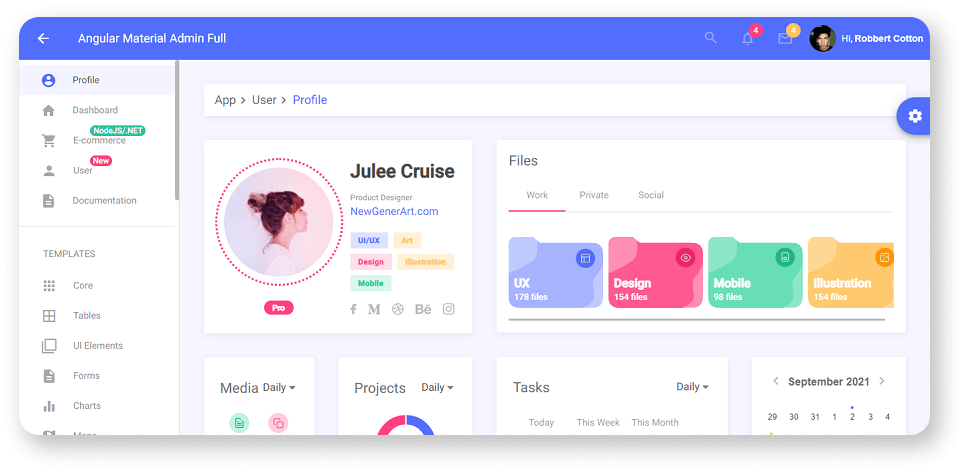
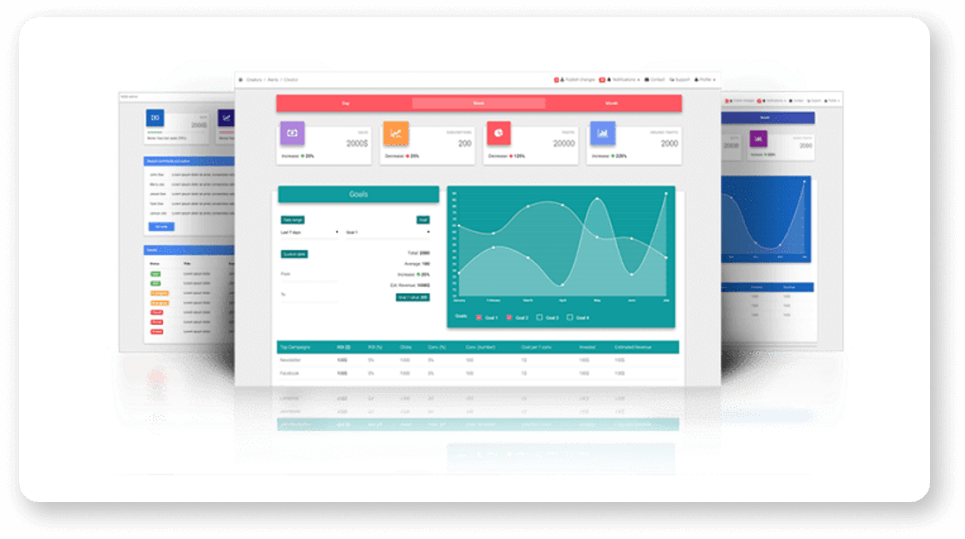
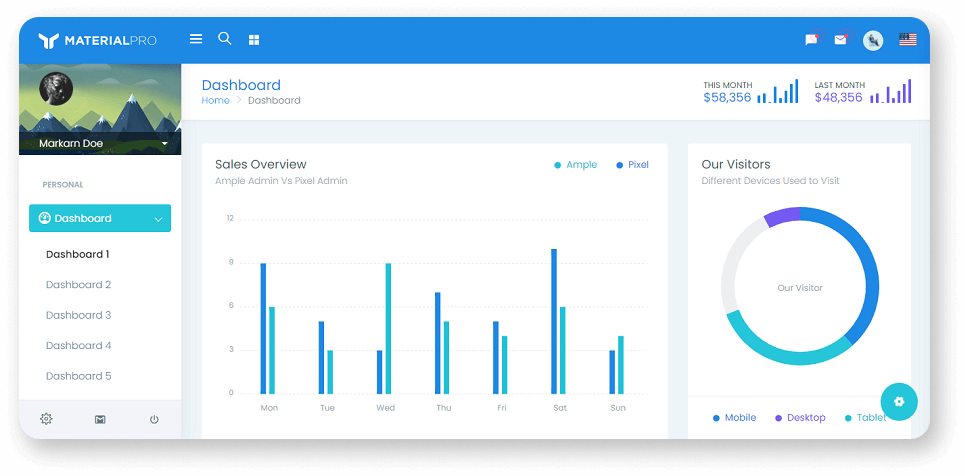
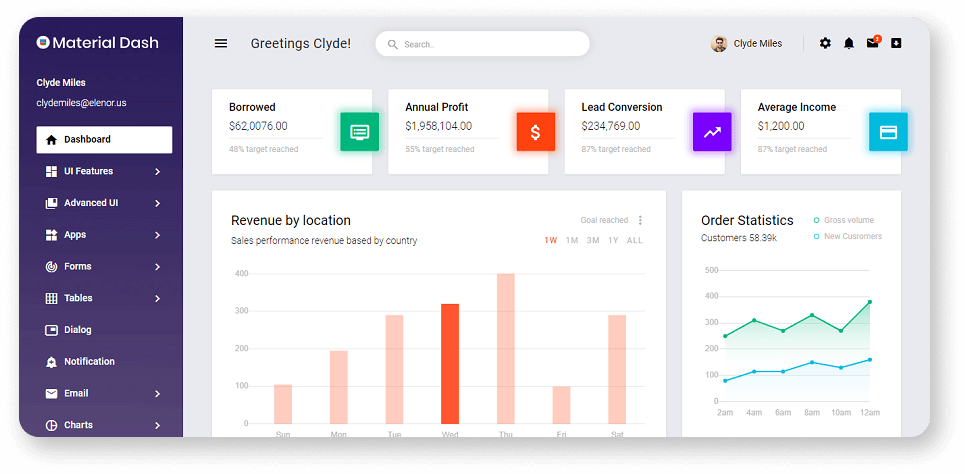
    You’re probably looking for the best Material Design Admin Templates. The great ones are here. I’ve carefully handpicked only the best ones which have excellent support, design, features, and components. All of these beautiful templates have used powerful technologies, for example, React, Vue, Angular, HTML, etc. So, let’s take a look at these best material design admin templates and pick a few that matches your criteria.

    Egret – React Redux Material Design Admin Dashboard Template

    Egret - React Redux Material Design Admin Dashboard Template

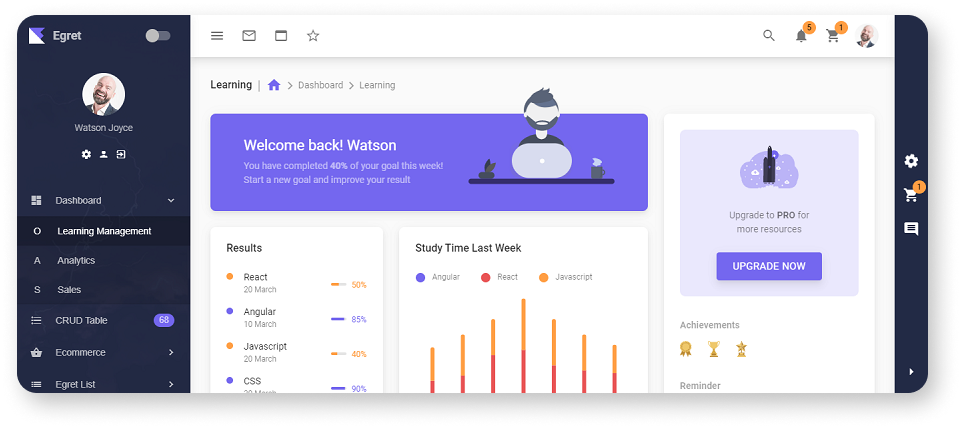
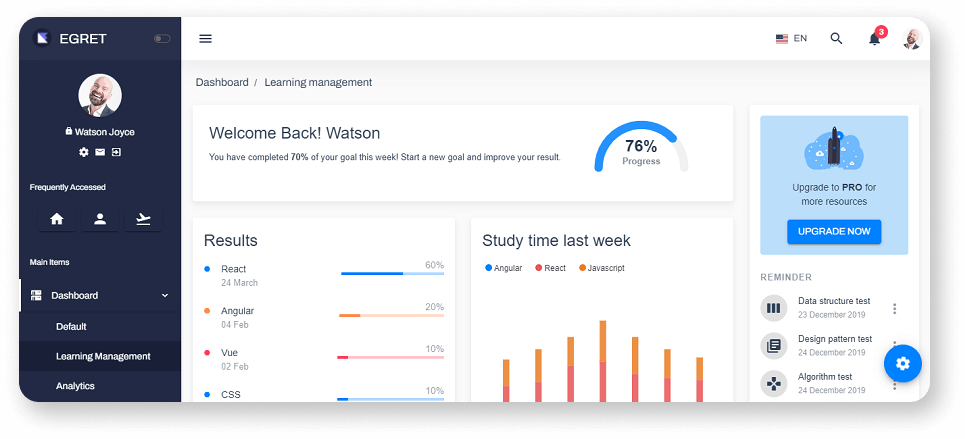
    Egret is one of the most powerful Admin Templates developed by UI-Lib with React, Redux, and Material UI. This developer-friendly, highly customizable admin template will be a great start for building the front-end for online education, SaaS, and a lot of other project types. Its company ensured the highest industry standards. Moreover, it is also scalable and easy to use.

    The template is full of excellent features, UI components, ready-to-use apps, and proper documentation. It offers apps like chat, event calendar, inbox, invoice builder, to-do list, Crud list, etc. Also, it has multiple dashboards like online education, analytics, and sales. There are multiple layouts and more than 50 React UI Kits, Google map, user profile, drag & drop, plan & pricing, and a lot more.

    Besides, this amazing admin template has react-router-dom for routing and role-based authentication. Experience this highly qualified admin template to make your next big backend project from the button below.

    Demo / Download

    Vue Material Template Full

    Vue Material Template Full

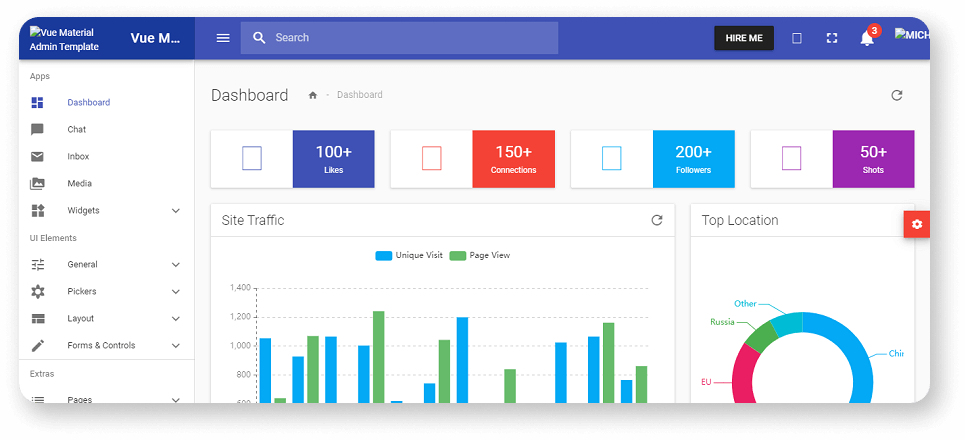
    Vue Material Template is a premium quality admin template with Vuetify framework, Vue, and material design. It is free of Bootstrap and JQuery dependencies. Also, it is a clean-code template with frequent updates and technical support.

    The template comes with three color themes, multiple pages, an eCommerce section, multiple chart libraries, user management, and more. Furthermore, it has the perfect folder structure, as shown in the description link.
    With Vue Material Template, you will get six months of technical support and twelve months of free updates.

    Demo / Download

    Vue Material Admin – Material Design Admin Template (free)

    Vue Material Admin - Material Design Admin Template (free)

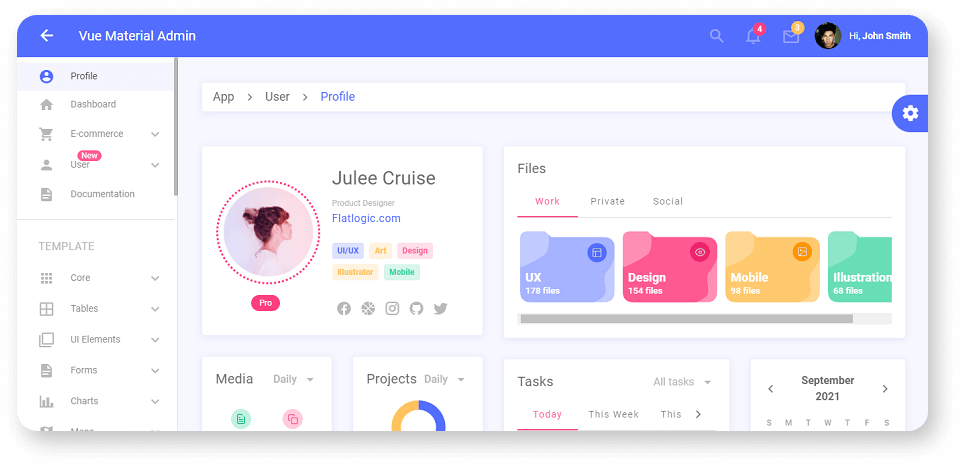
    If you’re looking for an admin template, free of cost but has all the premium features, this is a perfect choice. Vue Material Admin is a free material design admin template with Vue and Vuetifyjs. It comes with tons of features. And, it has all the premium features that you can easily create a complex admin section with this template.

    The template contains built-in widgets, apps, multiple layouts, two types of Pickers, etc. Besides, it is not enough to read this article to know everything about this simple yet, outstanding material design admin template. Check out the description and demos from the link below.

    Demo / Download

    Angular Material Admin Template

    Angular Material Admin Template

    Angular Material Admin Template can help you create admin areas for CMS, SaaS, Visualization apps, etc. The template is well responsive, versatile, and has good documentation attached to it. So, you can clearly visualize the data and have a faster user experience.

    The template offers 100+ pages, two type charts, multiple dashboards, theme support, and a lot more. Also, it has graphics for data visualization, no JQuery dependencies, no Bootstrap, and an eCommerce section.

    Demo / Download

    Material Dashboard – Bootstrap 4 Material Admin (free)

    MDB

    Material Dashboard is a free Bootstrap 4 Material Admin template. It has easy-to-use components with plugins redesigned to fit in with other elements. The dashboard makes use of light, movement, and surface. It has 5 color filter choices, which is a great thing for matching the design experience with your requirements.

    Moreover, this dashboard template contains 60 elements, 02 plugins, 03 example pages, full documentation, and SASS files. Additionally, it gives an option to have a background image on the sidebar. There is also a premium version available, make sure to check that out as well.

    Demo / Download

    Material Design for Bootstrap (free) – Angular version

    Material Design for Bootstrap (free) - Angular version

    MD Bootstrap is a free admin template that contains large-scale UI Kits for both personal and commercial use under the MIT license. It is a fully responsive design and maintains a perfect overall balance of different structures. Though it is a free product it contains a pack full of features and components.

    The template provides more than 600 material icons, 74 animations, and over 400 material UI elements. Every 1 or 2 months the template updates with a new bunch of items.

    It offers a knowledge base of support questions. Github community answers and helps users to figure out better solutions for a problem. However, for commercial purposes, you have bought it, which varies from €599 to €3449.

    Demo / Download

    Material Pro Dashboard

    Free MDB Template

    Material Pro Dashboard is a beautiful admin template with a flat design. Built on top of the Bootstrap framework, this template provides a mega-collection of features and elements. They say it contains more than 500 UI components, light & dark versions, over 100 plugins, 900+ pages, and 3000+ font icons.

    The template gives full RTL support, one year of full technical support, and free updates. They say that they are 24/7 open to supporting their clients.

    Demo / Download

    Material Dash Pro – Material Design Admin Dashboard Template

    Material Dash Pro

    Material Dash Pro is an elegant admin dashboard template. It follows Google’s material design guidelines. The template has a ton of example pages along with UI components, 3rd party plugins, and a lot more. You can create a fully functional admin area easily with this minimal-looking template.

    Moreover, it offers inboxes, charts, and unbeatable technical support. Make sure to check out this beautiful template from the live preview section. And read the details for a clear understanding of what are the things that it contains.

    Demo / Download

    Egret – Angular 12+ Material Design & HTML Admin Template

    Egret Angular Material Design and HTML Admin Template

    Egret Angular is another version of Egret with TypeScript, Angular CLI, Angular Material, and Flex-Layout. The template has no JQuery dependencies and Bootstrap. However, it provides one of the finest codebase and design quality for its users. Moreover, it is an exceptional collection of components that are both reusable and well responsive.

    Besides, this outstanding admin template contains light & dark themes, multiple layouts, page templates, lazy loading, multiple apps, and a lot more.

    So far, it has got a large number of positive reviews from customers. Check out the demos and download this beautifully crafted admin template from here.

    Demo / Download

    Wrapping Up

    To conclude this blog, I would like to say, before choosing any of these best material design admin templates or other ones, make sure you have gone through all the details. make a list of your requirements, search for them in these templates then select one for a trial. Only after a successful trial, you can buy an extended license for a commercial launch. So, wishing you all the best for your next backend project.

    Here is an article that can help you choose the best admin template. Step by Step Guide

    Take a look at Our Themeforest Profile

    Our Gumroad Profile

  • React Techniques with Performance

    React Techniques with Performance

    Are you a React developer looking forward to knowing about React Techniques with Performance. Don’t worry. Here, we are going to give you exactly what you’re looking for.

    React Techniques with Performance

    I prefer using Visual Studio. For React development you can use the Simple React Snippet extension in VsCode (Visual Studio). To use this extension facilities like autosuggestion or pre-built snippet you have to save your file as .jsx (eg. MyFile.jsx). Follow the above link to get snippet shortcuts to code faster.

    Important: If you are using any secret key/client key in your app, then it’s better not to use them inside your source folder or in the index.html file. Because this can easily expose to others. So, what you can do is add a file with the name .env and put your secret/client keys there.

    .env file will look like below

    CLIENT_KEY = AIzaSyAYdp6JWy6aD-2Jiil3ggePxDSBDIMpD-KF

    To use these keys inside your app you have to use process.env.CLIENT_KEY. Don’t forget to add this .env file in .gitignore to avoid sharing these keys in Github.

    Invoke child function from parent:

    We may face situations where we need to invoke a child function from parent. Suppose, we have two components named Parent.jsx and Child.jsx. In our Child component, we have a function name triggerChild() which will invoke from the Parent component. Let’s have a look at the files/components below

    import React, { Component } from 'react';
    import Child from './Child';
    class Parent extends Component {
        childFunction;
      
        setChildFunction = functionRef => {
            this.childFunction = functionRef;
        }
        
        render() {
            return (
              <div>
                 <Child setChildFunction={this.setChildFunction}></Child>
                <button onClick={this.childFunction}>Trigger Child</button>
              </div>
            );     
        } 
    } 
    export default Parent;

    First we created a variable called childFunction that would hold the child function passed from Child component through setChildFunction().
    Then we make a function name setChildFunction() which will pass to Child as props.
    This setChildFunction() receives a parameter (function) and set  it to childFunction variable which we created earlier.

    import React, { Component } from 'react';
    class Child extends Component {
      
        triggerChild = () => {
            console.log("child triggered from parent");
        }
        
        componentDidMount() {
            let {setChildFunction} = this.props;
            setChildFunction(this.triggerChild);
        }
        render() {
            return (
              <div>                
                <div>Child</div>
              </div>
           );
        }
    }
    export default Child;

    In this Child component, We passed the triggerChild function to Parent through setChildFunction when the component is rendered.  That’s why inside componentDidMount() we grabbed the setChildFunction from props and invoked this function with this.triggerChild parameter which set this triggerChild function to our parent variable (childFunction). Now, when we nee

    Performance Issues:

    1. If any async function that will update the state of the component is called anywhere in the component then it must be unsubscribed or destroyed inside componentWillUnmount() function before the component unmounts.

    2. It’s better to use invoke any async function inside componentDidMount(). Because, if async function updates state before the component mounts, this will create an error, that is not in your expectation.

    3. If you want to render a list, you can use a unique key for each item in the list. Here you might want to use index as key from map of a list. But this will cause performance issues when you want to delete or edit certain items in that list. You can use shortId for generating the short unique keys.

    4. When rendering a long list it’s better to use an infinite scroll or load more mechanisms to increase performance. Because they render items based on user interaction.

    Our React Products

    https://ui-lib.com/downloads/bazar-pro-react-nextjs-ecommerce-template/

    Gull – React Bootstrap 5 Admin Dashboard Template

    Learn more about us HERE.